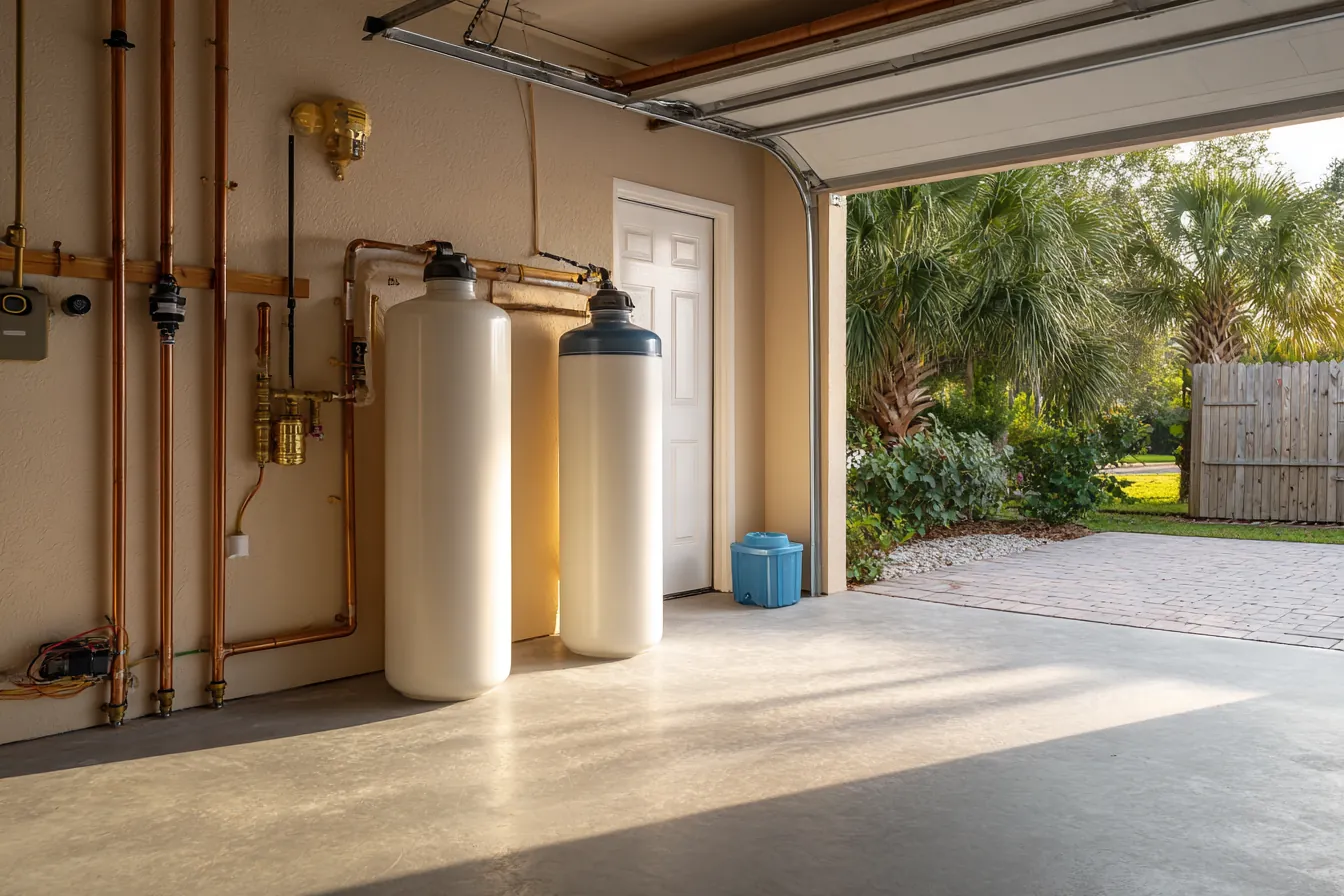
WATER TREATMENT · SEO SERVICES
Water Treatment Company SEO Built on the Utility's Own Water Report
Water treatment company SEO in Southwest Florida runs into an awkward fact: some of the utilities your customers rely on publish reports saying their water is not hard. The industry's habit of selling every homeowner a softener collides with those reports, with the Attorney General's warnings about free water tests, and with Florida's in-home sales law. The companies that win search here sell to the real problem, and prove it.
 Jamie Kloncz, founder. Does the work himself, from Naples.
★★★★★ 5.0 on GoogleNaples, FloridaMonth to month
In one paragraph
Water treatment company SEO is the work of making a softener, filtration or well water company the most credible local answer to a homeowner's water question, built on the utility's published water quality data, the state's well guidance and Florida's sales and licensing rules. SEO Elite Agency builds that for water treatment companies across Naples and Southwest Florida, month to month, starting with a free audit.
01 / 10
Is Southwest Florida City Water Actually Hard?
Not by the utilities' own numbers. Collier County reported district water of "42 to 94 mg/L, or 2.4 to 5.5 grains per gallon, with an average hardness of 67 mg/L" for 2024 (Collier County, 2025), which its own scale calls moderately hard. Cape Coral reports "5.5 to 6.5 grains per gallon of total hardness" (City of Cape Coral, 2026).
Start where a careful buyer starts: the water report the utility mails out every year.
Collier County's 2024 annual drinking water report sets out the scale first: "0 to 60 milligrams per liter (mg/L) of hardness is classified as soft water; 61 to 120 mg/L as moderately hard water; 121 to 180 mg/L as hard water; and more than 180 mg/L as very hard water" (Collier County, 2025). It then reports that the range delivered by the Collier County Water Sewer District "was 42 to 94 mg/L, or 2.4 to 5.5 grains per gallon, with an average hardness of 67 mg/L" (Collier County, 2025). On the report's own scale, that average is moderately hard.
Cape Coral is more direct still. Its 2025 report states that "city water has 5.5 to 6.5 grains per gallon of total hardness" (City of Cape Coral, 2026), and in its customer questions it asks and answers: "Do I need a water softener if I am on city water? No, because city water is not hard water" (City of Cape Coral, 2026). It describes its water as "in the range of soft to moderately hard" and calls that "the most desirable range from a consumer standpoint" (City of Cape Coral, 2026).
A water treatment website that tells Cape Coral city customers they have hard water is contradicting the utility in writing, and the customer can find the contradiction in a minute. The pages that earn trust here quote the report, explain what the numbers mean, and then talk honestly about the problems that remain: taste and chlorine, specific appliances, and above all, private wells.
We did not find a hardness figure in Lee County Utilities' or Fort Myers' current reports, and we could not read the City of Naples report at the source, so we publish no number for them. Your own pages should cite the report for each system you serve, and say plainly where a report is silent.
What the water report says
Collier’s water, on Collier’s own scale.
Hardness in mg/L, 2024, Collier County Water Sewer District. Collier County Annual Drinking Water Quality Report 2024, published 2025, read October 15, 2026.
- “On the report's own scale, that average is moderately hard.”
- “A water treatment website that tells Cape Coral city customers they have hard water is contradicting the utility in writing, and the customer can find the contradiction in a minute.”
- “Your own pages should cite the report for each system you serve, and say plainly where a report is silent.”
02 / 10
Where Each Utility's Water Comes From, and Why It Changes the Pitch
Collier treats groundwater with nanofiltration, reverse osmosis and lime softening and disinfects with chloramines (Collier County, 2025); Cape Coral relies on reverse osmosis of brackish Upper Floridan water (City of Cape Coral, 2026). Treatment upstream decides what a home system can usefully add.
Every service area in Southwest Florida has a different treatment story, and a page written for one system is wrong for the next.
Collier County's district pumps groundwater from three wellfields, and its plants use "nanofiltration," "reverse osmosis" and "lime softening," with water "treated with chloramines for disinfection purposes and a corrosion inhibitor to prevent corrosion of pipes" (Collier County, 2025). The chloramine detail matters for filter selection, which makes it a fact a Collier dealer should know and publish.
Cape Coral draws from "groundwater from the Upper Floridan Aquifer" with "a total dissolved solids (TDS) content of approximately 3,000 parts per million," and says it would be "the first city of significant size in the United States to make the decision to rely completely on reverse osmosis treatment as its only means of producing potable water" (City of Cape Coral, 2026). Fort Myers, similarly, "uses a reverse osmosis process to purify brackish (salty) water provided by the Floridan Aquifer" (City of Fort Myers, 2025). Lee County Utilities runs several plants using lime softening, reverse osmosis, nanofiltration and ion exchange on different aquifers, plus treated river water at its Olga plant (Lee County Utilities, 2026).
So the honest pitch differs by address. On a reverse osmosis supply, a whole-house softener is a hard sell to an informed buyer; a carbon filter for taste may be the right answer, and Cape Coral's own report suggests one: "an inexpensive activated carbon (charcoal) filter, which you can install on your kitchen sink" (City of Cape Coral, 2026). On a private well, the conversation is entirely different. Service-area pages that explain the local supply before recommending anything are the ones a careful buyer believes.
Southwest Florida, utility by utility
Same coast. Different water.
01 / 06 · Collier County district
“the range delivered by the Collier County Water Sewer District "was 42 to 94 mg/L, or 2.4 to 5.5 grains per gallon, with an average hardness of 67 mg/L"”
Moderately hard on average, by the county’s own scale.
02 / 06 · How Collier treats it
“Collier treats groundwater with nanofiltration, reverse osmosis and lime softening and disinfects with chloramines”
The chloramines in this supply shape which filter fits.
03 / 06 · Cape Coral, in grains
“city water has 5.5 to 6.5 grains per gallon of total hardness”
The city’s own 2025 report, in grains per gallon.
04 / 06 · Cape Coral, on softeners
“Do I need a water softener if I am on city water? No, because city water is not hard water”
The utility answers the softener question itself.
05 / 06 · Fort Myers
“uses a reverse osmosis process to purify brackish (salty) water provided by the Floridan Aquifer”
A reverse osmosis supply, which changes what a home system can add.
06 / 06 · Where the reports are silent
“We did not find a hardness figure in Lee County Utilities' or Fort Myers' current reports, and we could not read the City of Naples report at the source, so we publish no number for them.”
No number found, so no number given.
County lines: US Census Bureau.
03 / 10
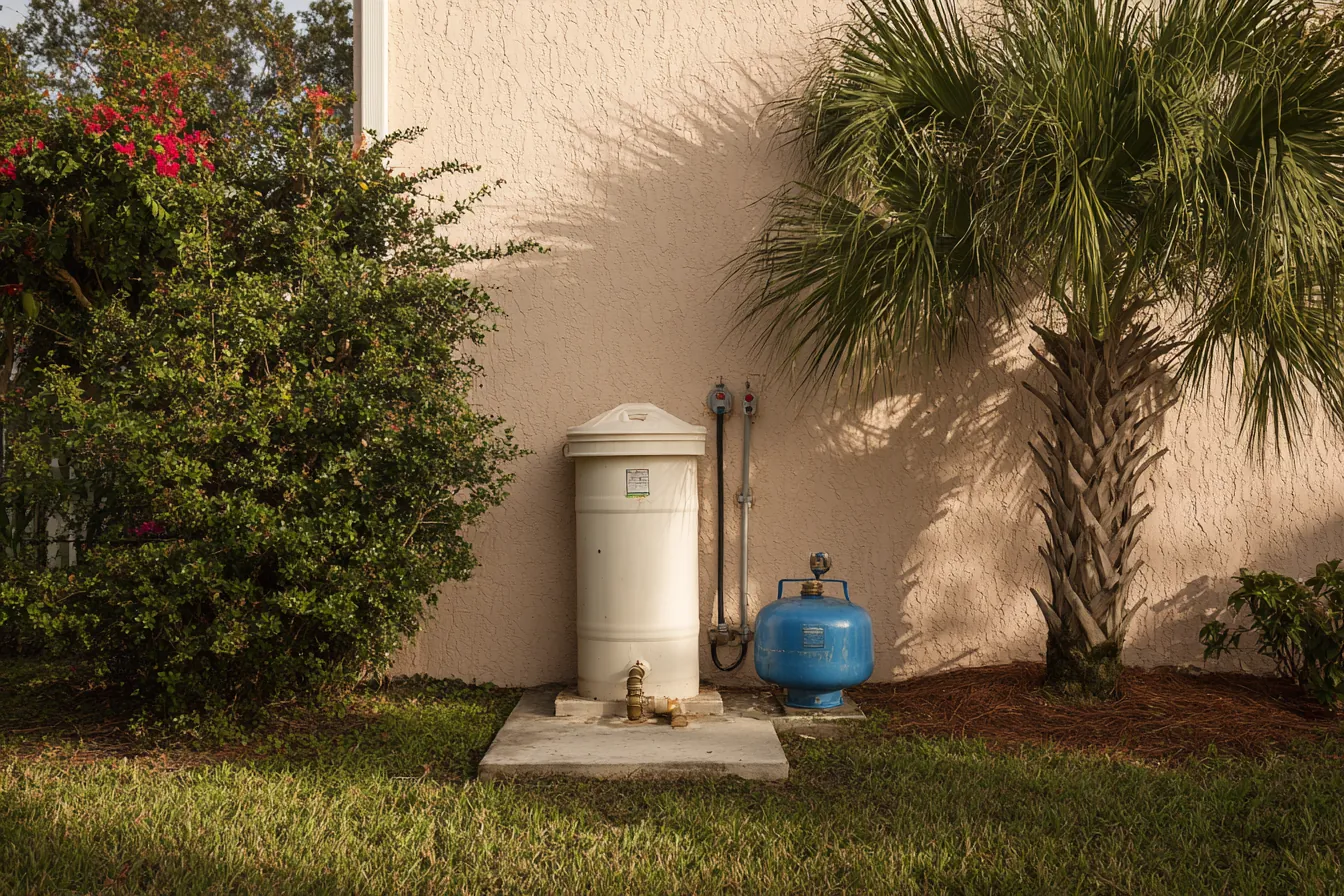
Private Wells Are Where Treatment Starts With a Test
The Florida Department of Health "strongly recommends that you test your water for bacteria and nitrate at least once per year" and notes that "the state of Florida does not have requirements for routine private home well water sampling" (Florida Department of Health, 2026). Well owners are the buyers whose water nobody else is testing.
If you own a water treatment company in Southwest Florida, the homeowners whose water genuinely varies are those on private wells, and the state tells them to test.
The Department of Health says: "If you have a private well, the Florida Department of Health strongly recommends that you test your water for bacteria and nitrate at least once per year" (Florida Department of Health, 2026). It adds that "the state of Florida does not have requirements for routine private home well water sampling," that "most homeowners should test for lead every three years," and that the local county health department "can provide you with instructions on how to collect the water samples yourself and to have them tested (usually $20-30 per sample)" (Florida Department of Health, 2026). The state lab lists a well bacteria test at "$40 for private testing" (Florida Department of Health, 2026).
The department also explains a problem that sends homeowners searching: "Hydrogen sulfide gas (H2S) can occur in wells anywhere in Florida," and "if the smell is coming from both the hot and cold faucets, but only from the water treated by a water softener and not in the untreated water, the problem likely is sulfur bacteria in the water softener" (Florida Department of Health, 2025). It names treatment options including "aeration, oxidation, and adsorption" (Florida Department of Health, 2025).
That is a content plan for a well water company: an independent testing page that sends owners to the health department or a certified lab rather than selling a test, a sulfur smell diagnostic built on the department's own sheet, and system pages that start from a lab result. The honesty is the sales tool. A company that tells a well owner to get the state's test first is the company the owner calls back with the results.
04 / 10
What Florida Says About the "Free Water Test"
The Florida Attorney General warns that "fraudulent sellers that advertise 'free home water testing' may only be interested in selling you their water treatment device," and that claims "the government has approved the seller's particular method of in-home water testing" are false (Florida Office of the Attorney General, 2026).
Most water treatment marketing advice recommends a free in-home water test as the lead offer. In Florida, the state's top law enforcement office has a page warning consumers about exactly that.
The Attorney General's consumer guidance says "fraudulent sellers that advertise 'free home water testing' may only be interested in selling you their water treatment device, whether you need it, or not," describes salespeople who "add tablets or droplets of chemicals to your tap water," and observes that "in almost all of these cases, any water (even spring water) would 'fail' the company's test" (Florida Office of the Attorney General, 2026). It adds that claims that agencies "require or recommend that households use water purification systems, or that the government has approved the seller's particular method of in-home water testing" are false, and that an EPA registration number "means only that the manufacturer has registered its product with the Environmental Protection Agency, but not that the EPA has tested or approved the product" (Florida Office of the Attorney General, 2026).
The office has also acted. In 2021 it announced legal action against a Florida company it said sold drinking water systems "with promises of unproven health benefits and using deceptive financing offers" (Florida Office of the Attorney General, 2021). Those were allegations in a lawsuit, and the page does not report the outcome, but the message about how regulators view the category is clear.
For SEO, the conclusion is to replace the gimmick with the real thing. If you offer testing, name the method, say what it measures and what it does not, and point to the state's own recommended tests. Every page that says "free test" invites a homeowner to read it in the Attorney General's voice.
05 / 10
In-Home Sales Come With a Permit and a Three-Day Right to Cancel
Florida gives buyers "the right to cancel a home solicitation sale until midnight of the third business day after the day on which the buyer signs" (Florida Statutes section 501.025, 2026), and requires a home solicitation sale permit from the clerk of the circuit court (Florida Statutes section 501.022, 2026).
Water treatment is one of the trades most often sold at the kitchen table, and Florida regulates that setting directly.
Florida law provides that "the buyer has the right to cancel a home solicitation sale until midnight of the third business day after the day on which the buyer signs an agreement or offer to purchase" (Florida Statutes section 501.025, 2026). It also makes it unlawful "to conduct any home solicitation sale" without "first obtaining a valid home solicitation sale permit," with applications filed "with the clerk of the circuit court for the county in which applicants intend to conduct home solicitation sales" (Florida Statutes section 501.022, 2026). The statute defines a home solicitation sale around a purchase price "in excess of $25," and excludes sales that result "from a request for specific goods or services by the purchaser" (Florida Statutes section 501.021, 2026). Whether a booked in-home consultation falls inside that exclusion is a question for counsel, not for a marketing page.
The federal rule covers similar ground. The FTC's cooling-off rule applies to sales where the seller "personally solicits the sale, including those in response to or following an invitation by the buyer," at "$25 or more if the sale is made at the buyer's residence" (16 CFR Part 429, 2026).
The financing side carries its own history. In 2024 the FTC announced that its action against a water treatment financing company led to "$20 million in refunds and an additional $23.6 million in debt forgiveness," after dealers allegedly went "door-to-door, deceiving consumers about the financing terms for water filtering and softening products" (Federal Trade Commission, 2024).
A water treatment website that states the cancellation right plainly, shows the permit, and explains financing terms before anyone visits the house is not giving anything away. It is removing the main reason a cautious buyer hesitates to let a salesperson in.
In-home sales, checked
Before the kitchen table.
Florida’s definition leaves out sales that start from the buyer’s own request for specific goods or services. The federal rule still reaches visits the buyer invited.
Whether a booked in-home consultation falls inside that exclusion is a question for counsel, not for a marketing page.
Who started the in-home sale?
Do you hold the home solicitation sale permit for this county?
First the permit, from the county clerk.
“It also makes it unlawful "to conduct any home solicitation sale" without "first obtaining a valid home solicitation sale permit," with applications filed "with the clerk of the circuit court for the county in which applicants intend to conduct home solicitation sales"”
The buyer can cancel until midnight of business day three.
“the buyer has the right to cancel a home solicitation sale until midnight of the third business day after the day on which the buyer signs an agreement or offer to purchase”
The federal rule covers invited visits too.
“The FTC's cooling-off rule applies to sales where the seller "personally solicits the sale, including those in response to or following an invitation by the buyer," at "$25 or more if the sale is made at the buyer's residence"”
06 / 10
Certification Is the Trust Signal, and It Is Checkable
EPA's WaterSense guide advises choosing a softener "certified to NSF/ANSI 44" and notes that certification "helps ensure that the manufacturers' claims are independently verified and accurate" (U.S. Environmental Protection Agency, 2024). NSF's public listing let us count 2,377 certified products from 65 manufacturers on October 15, 2026 (NSF, 2026).
In a category regulators warn about, independent certification is the cleanest proof a company can offer, and buyers can check it themselves.
EPA's WaterSense guide, published in November 2024, says: "When selecting a water softener or conditioner, make sure to choose one that has been certified to NSF/ANSI 44 Requirements for Water Softeners or International Association of Plumbing and Mechanical Officials (IAPMO)/ANSI Z601 Standard for Scale Reduction Devices" (U.S. Environmental Protection Agency, 2024). It notes that "NSF/ANSI 44 includes a voluntary efficiency rating that requires softeners to use 5.0 gallons of water or fewer per 1,000 grains of hardness removed" (U.S. Environmental Protection Agency, 2024).
NSF publishes its listings openly. On the morning of October 15, 2026, its NSF/ANSI 44 listing showed "Number of matching Manufacturers is 65" and "Number of matching Products is 2377," with codes such as "[HR] Hardness Reduction" and "[ER] Softener Efficiency" explained on the page (NSF, 2026). It also marks some listed components "[1] Conforms to material and structural integrity requirements only" (NSF, 2026), which is not the same as a certified softener.
That gives a product page a sentence competitors rarely write: the model we install, its NSF listing, which claims it carries, and a link so the buyer can confirm it. EPA makes the reverse point about registration: "EPA registration (unlike that of NSF, WQA, or UL) is not intended to guide consumers in selecting a water treatment device, and is not an endorsement of the product" (U.S. Environmental Protection Agency, 2005). That document is old, and the Attorney General restates the same principle today.
07 / 10
Do Water Treatment Installers Need a Plumbing License in Florida?
Florida exempts "the installation and maintenance of water conditioning units for domestic, commercial, or industrial purposes by operators of water conditioning services" from contractor licensing, and bars counties and cities from requiring such an operator "to become licensed, certified, or registered as a plumber" (Florida Statutes section 489.103, 2026).
This is one of the questions homeowners ask before they let anyone touch their plumbing, and the answer is unusually specific.
Florida's contractor licensing law "does not apply to" the "installation and maintenance of water conditioning units for domestic, commercial, or industrial purposes by operators of water conditioning services," and it provides that "no municipality or county may adopt an ordinance, rule, or regulation which requires such an operator to become licensed, certified, or registered as a plumber" (Florida Statutes section 489.103, 2026). The statute does not define "water conditioning units," so whether a particular reverse osmosis or whole-house filtration system falls within it is a question for the company's counsel, not something a website should assert.
Two related lines keep the picture honest. The minor-work exemption under $2,500 does not apply "to a person who advertises that he or she is a contractor or otherwise represents that he or she is qualified to engage in contracting" (Florida Statutes section 489.103, 2026). And Collier County lists "Repair/replacement of water purification/water softener equipment" among permit exemptions for detached single-family homes, while warning that exemptions do not authorize work "in violation of the provisions of this code" (Collier County, 2026).
For the website, say what the statute says, describe what you install and how, and show whatever credentials your people hold, such as a plumbing license for the work that needs one or manufacturer certifications for the equipment. A buyer who has read about door-to-door water schemes is reassured by precision, not by vague "licensed and insured" badges.
08 / 10
Waste Water, Salt and the Questions Environmentally Minded Buyers Ask
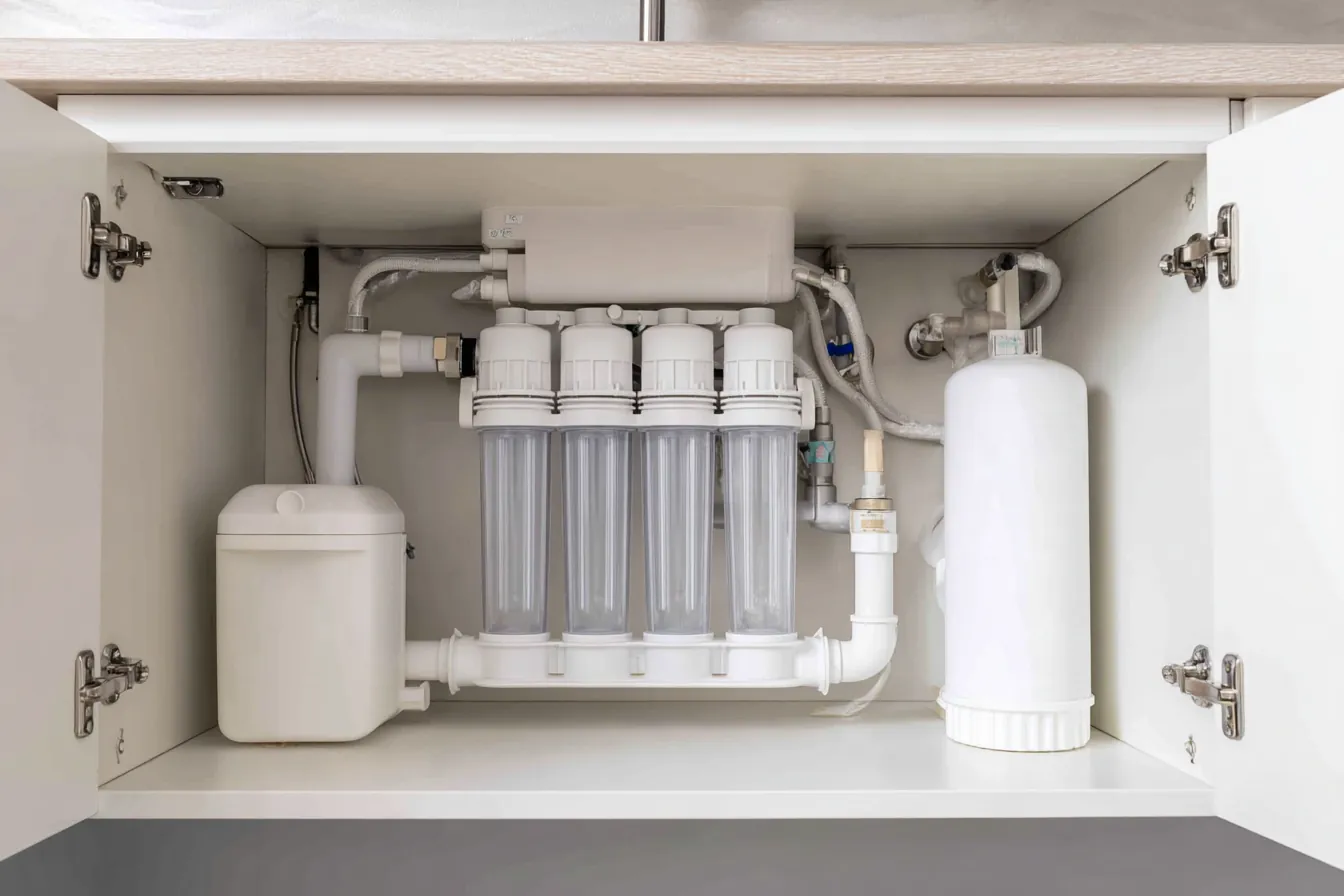
EPA estimates that "a typical point-of-use RO system generates at least five gallons of water waste for every gallon of treated water," while WaterSense labeled models generate "2.3 gallons of water waste or less," and it notes that softeners "discharge salts" and that some localities restrict them (U.S. Environmental Protection Agency, 2024).
A growing share of buyers ask about efficiency before they ask about price, and the federal guidance gives a company concrete numbers to answer with.
EPA's guide says that "a typical point-of-use RO system generates at least five gallons of water waste for every gallon of treated water it produces, while some inefficient models can consume up to 10 gallons," and that "WaterSense labeled models generate 2.3 gallons of water waste or less for every gallon of treated water produced" (U.S. Environmental Protection Agency, 2024). On softeners, it says "cation exchange water softeners can impact local water quality because they discharge salts as part of the treatment process," so "some local jurisdictions have restrictions on the installation and use of these systems" (U.S. Environmental Protection Agency, 2024).
It also offers a line every softener page could carry: "While some water hardness is generally not a health hazard, water softeners can be used to remove excessive hardness" (U.S. Environmental Protection Agency, 2024). That is a fair framing, and it positions the company as an advisor rather than an alarmist.
We looked for a Florida rule on softener discharge into septic systems and found none in the state's onsite sewage rule, so we make no claim either way. Pages on efficient RO models, WaterSense labels and salt use, written with these figures, answer questions most competitors never address and attract the buyer who researches before calling.
Hard water, honestly
The honest pitch, one fixture at a time.
01 / 05 · Start with the report
“Start where a careful buyer starts: the water report the utility mails out every year.”
02 / 05 · Explain what the numbers mean
“The pages that earn trust here quote the report, explain what the numbers mean, and then talk honestly about the problems that remain: taste and chlorine, specific appliances, and above all, private wells.”
03 / 05 · Frame hardness fairly
“While some water hardness is generally not a health hazard, water softeners can be used to remove excessive hardness”
04 / 05 · Private wells are where water varies
“the homeowners whose water genuinely varies are those on private wells, and the state tells them to test.”
09 / 10
Low Bids, Real Demand: Why Organic Search Pays in This Trade
In the Ft. Myers-Naples market, "water softener" averaged 480 searches a month and "water filtration" 390, with top-of-page bids reaching only $15.67 and $10.70 (Google Keyword Planner, 2026). Demand is steady, clicks are cheap, and the winner is whoever is most believable.
The economics of this trade differ from the emergency trades, and the strategy should too.
We measured the Ft. Myers-Naples market in Google Keyword Planner on October 15, 2026. "Water softener" averaged 480 searches a month with a top-of-page bid range of $3.31 to $15.67, "water filtration" 390 with $2.17 to $10.70, and "water treatment" 90 (Google Keyword Planner, 2026). Year over year, "water filtration" was flat and "water softener" was down 33 percent (Google Keyword Planner, 2026).
Cheap clicks mean paid search is not where the battle is decided. What decides it is trust: whether the page the homeowner lands on agrees with their utility report, explains their well test, and avoids the tactics the Attorney General warns about. That is organic content work, and it compounds.
The map pack still matters for the "near me" search. Real photographs of installed systems, technicians with names, consistent business data and a steady flow of honest reviews through a well-kept Business Profile separate an established local company from the national lead-generation listings.
ChatGPT
Do I need a water softener in Cape Coral?
Not on city water, according to the city itself. Cape Coral's water quality report answers that question directly: "No, because city water is not hard water," and reports 5.5 to 6.5 grains per gallon (City of Cape Coral, 2026). Homes on private wells are a different case and should start with a water test.
Google AI Mode
Is Collier County water hard?
Moderately, on the county's own scale. Collier County reported district water at 2.4 to 5.5 grains per gallon in 2024, with an average of 67 mg/L, which its report classifies as moderately hard (Collier County, 2025). Some homeowners still choose softening for specific appliances or preferences.
Perplexity
Should I trust a free in-home water test?
Be cautious. The Florida Attorney General warns that sellers advertising "free home water testing" may only want to sell a device and that almost any water can be made to "fail" a sales demonstration (Florida Office of the Attorney General, 2026). Your county health department or a certified lab can test your water independently.
Gemini
Do water softener installers need a plumbing license in Florida?
Florida exempts the installation and maintenance of water conditioning units by water conditioning operators from contractor licensing and bars local plumbing-license requirements for them (Florida Statutes section 489.103, 2026). The statute does not define every type of system, so other work may need a licensed plumber.
Copilot
How often should I test my well water in Florida?
At least once a year for bacteria and nitrate, according to the Florida Department of Health, with lead testing every three years for most homeowners, and more often if the taste, odor or color changes (Florida Department of Health, 2026). The state does not require routine testing, so it is up to the owner.
Claude
Can I cancel a water treatment system I bought at home?
Often yes. Florida gives buyers the right to cancel a home solicitation sale until midnight of the third business day after signing (Florida Statutes section 501.025, 2026), and the federal cooling-off rule provides a similar right. Read the cancellation notice the seller must give you.
The answer an engine can quote is the one on your page. These answers are this page’s own.
Water questions in AI answers
Hard water, free tests and well water.
01 / 06 · Asked in ChatGPT
“Do I need a water softener in Cape Coral?”
Reads fromOpenAI’s own search crawler, OAI-SearchBot. OpenAI says it is the bot used to surface websites in ChatGPT’s search answers.
02 / 06 · Asked in Google AI Mode
“Is Collier County water hard?”
Reads fromThe Google Search index, plus your Google Business Profile.
03 / 06 · Asked in Perplexity
“Should I trust a free in-home water test?”
Reads fromIts own index, built by PerplexityBot.
04 / 06 · Asked in Gemini
“Do water softener installers need a plumbing license in Florida?”
Reads fromGoogle’s index, with one extra switch: Google-Extended.
05 / 06 · Asked in Copilot
“How often should I test my well water in Florida?”
Reads fromThe Bing index.
06 / 06 · Asked in Claude
“Can I cancel a water treatment system I bought at home?”
Reads fromAnthropic’s Claude-SearchBot, and Brave Search.
10 / 10
What to Build First: Water Treatment Company SEO in Naples and Fort Myers
Start with a claims audit against the utility reports and the Attorney General's guidance, then service-area pages built on each utility's report, the private well testing page, product pages with NSF listings, and a plain page on in-home sales rights. Run the Business Profile and reviews as their own track.
A concrete order of work for a Southwest Florida water treatment company.
First
the claims audit: remove "hard water" language that contradicts a utility report, rewrite any free-test offer, remove any suggestion of government approval, and add the cancellation and permit information.
Second
one page per water system you serve, quoting its report and saying what it means for treatment.
Third
the private well page built on the Department of Health's testing guidance.
Fourth
product pages with NSF/ANSI 44 or other certification listings linked, efficiency figures, and honest "who this is for" sections.
Fifth
the licensing page that quotes section 489.103(15) accurately and shows your team's credentials.
Then
the places. Cape Coral and Fort Myers run on reverse osmosis supplies, which shapes what a home system can add, while Naples and Bonita Springs pages should cite the report of whichever utility serves the address, with Collier County's district report where it applies, and speak to the homes on private wells. A page about a place should contain things only someone who services water systems there would write.
If you would rather have this built and maintained than written between installs, that is what we do, month to month, from Naples.
Estimate it
What might SEO cost and take for you?
Three questions, an honest range. This uses real Southwest Florida market rates and observed timelines, not a canned package price. It is an estimate to orient you, never a quote. The real number comes from a free audit of your actual site.
1 · HOW COMPETITIVE IS YOUR MARKET?
2 · WHERE IS YOUR SITE TODAY?
3 · WHAT ARE YOU AFTER?
ILLUSTRATIVE ESTIMATE
TYPICAL MONTHLY INVESTMENT
$1,700 – $3,100
/ month · month-to-month
TIME TO MEANINGFUL RESULTS
3 – 6 months
map pack movement, then attributed leads
Estimate from Southwest Florida market rates. Not a quote. Your audit sets the actual scope and price.
Watch it work
Turn on what makes AI recommend you.
AI recommends the businesses it can read, trust and quote. Flip on the four signals we engineer, and watch your visibility climb and the answer rewrite itself.
THE FOUR SIGNALS WE ENGINEER
Illustrative · the four signals are the real system we build
Real results
Said by the people who hired us.
5.06 reviews on Google
Read them on Google (opens in a new tab)-
★★★★★
I met Jamie a few years ago and have worked with him a lot. When we made the decision to rebrand and focus on our new commercial pressure washing business, we decided to go with Jamie at SEO Elite Agency and he has been outstanding! If you’re looking to scale your business by using all of the new Google Analytics tools and services, Jamie is the best at helping your customers find your business. You have to be known before there is a need and he will make sure you stand out in a crowded market.
Zachary GeraciGoogle review -
★★★★★
I recently hired SEO Elite Agency in Naples, FL, and I couldn't be happier with the results! From the initial consultation to the implementation of their strategies, Jamie was professional, knowledgeable, and genuinely invested in my success.
He took the time to understand my business goals and tailored their approach to meet my specific needs. Since working with him, I've seen a significant increase in my website's rankings and traffic. His communication was excellent, keeping me updated throughout the entire process.
Nicole BilliotGoogle review -
★★★★★
I had an excellent experience with SEO Elite Agency! After working with Jamie for only a short time, my website's traffic increased noticeably. Their transparent reporting and regular updates kept me in the loop every step of the way. I highly recommend using them if you are looking to boost your online presence.
David PattockGoogle review -
★★★★★
SEO Elite did not disappoint! Jamie really took the time to listen to my goals and implement them. He was very knowledgeable about SEO and was able to teach me how it works, which I really liked. Because of Jamie, I am ranking on google and getting more business! I could not recommend him enough!
Lauren SmallGoogle review -
★★★★★
Jamie is amazing! Within two weeks my business was ranked #1 organically and top 3 in the map pack. We’re really pleased with the results, highly recommended.
Genaro VasquezGoogle review -
★★★★★
Jamie is fantastic to work with and really boosted my website and SEO traffic. I highly recommend working with him!
Robin GrayGoogle review
Questions
What water treatment, softener and filtration companies ask us first.
Jamie Kloncz · SEO Elite Agency, Naples
Not on city water, according to the city itself. Cape Coral's water quality report answers that question directly: "No, because city water is not hard water," and reports 5.5 to 6.5 grains per gallon (City of Cape Coral, 2026). Homes on private wells are a different case and should start with a water test.
Jamie Kloncz · SEO Elite Agency, Naples
Moderately, on the county's own scale. Collier County reported district water at 2.4 to 5.5 grains per gallon in 2024, with an average of 67 mg/L, which its report classifies as moderately hard (Collier County, 2025). Some homeowners still choose softening for specific appliances or preferences.
Jamie Kloncz · SEO Elite Agency, Naples
Be cautious. The Florida Attorney General warns that sellers advertising "free home water testing" may only want to sell a device and that almost any water can be made to "fail" a sales demonstration (Florida Office of the Attorney General, 2026). Your county health department or a certified lab can test your water independently.
Jamie Kloncz · SEO Elite Agency, Naples
Florida exempts the installation and maintenance of water conditioning units by water conditioning operators from contractor licensing and bars local plumbing-license requirements for them (Florida Statutes section 489.103, 2026). The statute does not define every type of system, so other work may need a licensed plumber.
Jamie Kloncz · SEO Elite Agency, Naples
At least once a year for bacteria and nitrate, according to the Florida Department of Health, with lead testing every three years for most homeowners, and more often if the taste, odor or color changes (Florida Department of Health, 2026). The state does not require routine testing, so it is up to the owner.
Jamie Kloncz · SEO Elite Agency, Naples
Often yes. Florida gives buyers the right to cancel a home solicitation sale until midnight of the third business day after signing (Florida Statutes section 501.025, 2026), and the federal cooling-off rule provides a similar right. Read the cancellation notice the seller must give you.
Jamie Kloncz · SEO Elite Agency, Naples
No. SEO Elite Agency works month-to-month from our Naples office at 1950 Mayfair Street, Suite 313. Long contracts protect agencies from their own results, and we would rather earn the next month. Reach us at (843) 955-7727 or [email protected].
Sources
- Collier County: Annual Drinking Water Quality Report 2024 (published 2025), Collier County Water Sewer District, read October 15 2026 - hardness classification scale; 42 to 94 mg/L or 2.4 to 5.5 grains per gallon, average 67 mg/L; wellfields; nanofiltration, reverse osmosis and lime softening; chloramine disinfection
- City of Cape Coral: 2025 Annual Drinking Water Quality Report (published 2026), read October 15 2026 - Upper Floridan Aquifer, TDS approximately 3,000 ppm, reliance on reverse osmosis, 5.5 to 6.5 grains per gallon, "Do I need a water softener if I am on city water? No", carbon filter suggestion
- City of Fort Myers: 2025 Annual Water Quality Report, read October 15 2026 - reverse osmosis treatment of brackish Floridan Aquifer water
- Lee County Utilities: 2025 Water Quality Report (posted 2026), read October 15 2026 - treatment plants using lime softening, reverse osmosis, nanofiltration and ion exchange; Olga plant treating Caloosahatchee River water
- Florida Department of Health: private wells, state laboratory well water testing, and the well water odor and staining fact sheet (2025), read October 15 2026 - annual bacteria and nitrate testing recommended; no state requirement for routine sampling; lead every three years; county tests usually $20-30; state lab $40; hydrogen sulfide and softener sulfur bacteria; aeration, oxidation and adsorption
- Florida Office of the Attorney General: How to Protect Yourself: Water Treatment Devices (2026), and news release of August 10 2021, read October 15 2026 - free home water testing warning, chemical demonstrations, false claims of government approval, EPA registration is not approval; 2021 legal action alleging unproven health claims and deceptive financing
- Florida Statutes section 501.025: 2026 edition (read on Online Sunshine), read October 15 2026 - right to cancel a home solicitation sale until midnight of the third business day
- Florida Statutes section 501.022: 2026 edition, read October 15 2026 - home solicitation sale permit filed with the clerk of the circuit court
- Florida Statutes section 501.021: 2026 edition, read October 15 2026 - definition of home solicitation sale over $25 and the exclusion for sales resulting from a purchaser request
- 16 CFR Part 429: FTC Rule Concerning Cooling-Off Period for Sales Made at Homes or at Certain Other Locations, read October 15 2026 - covers sales following an invitation by the buyer at $25 or more at the residence
- Federal Trade Commission: press release, May 1 2024, action against Aqua Finance, read October 15 2026 - $20 million in refunds and $23.6 million in debt forgiveness; dealers deceived consumers about financing for water filtering and softening products
- U.S. Environmental Protection Agency: WaterSense Guide to Selecting Water Treatment Systems (November 2024) and Water Health Series: Filtration Facts (2005), read October 15 2026 - NSF/ANSI 44 certification, efficiency rating, RO waste water figures, softener salt discharge, hardness not generally a health hazard; registration is not an endorsement
- NSF: Official listings for NSF/ANSI 44 residential cation exchange water softeners, current as of October 15 2026, read October 15 2026 - 65 manufacturers and 2,377 products; claim codes HR and ER; component listings for material and structural integrity only
- Florida Statutes section 489.103: 2026 edition, read October 15 2026 - water conditioning installation and maintenance exempt from contractor licensing, no local plumbing-license requirement; minor work exemption does not cover anyone advertising as a contractor
- Collier County: permit exemptions for certain qualifying work (effective July 1 2026), read October 15 2026 - repair and replacement of water purification and softener equipment on detached single-family homes
- Google Keyword Planner: Ft. Myers-Naples FL DMA, October 2025 to September 2026, read by SEO Elite Agency October 15 2026 - water softener 480 (bid $3.31 to $15.67, year over year -33%), water filtration 390 (bid $2.17 to $10.70, year over year 0%), water treatment 90
Keep reading
Written by Jamie Kloncz, founderSEO Elite Agency, Naples FL. Last updated .
Start with the audit.
About 60 seconds, no email, and you get named findings for your own site, not a score out of a hundred.