TREE SERVICE · SEO SERVICES
Tree Service SEO Built on Florida Arborist, Mangrove and Permit Rules
Tree service SEO in Southwest Florida starts with a state law none of the agency pages we read for this trade mention: a signed assessment from an ISA certified arborist can take the permit out of a homeowner's tree removal. Add mangroves, swale trees, eagle nests and power lines, each with its own rule, and the company that explains them clearly is the one a homeowner trusts with a chainsaw over the roof.
 Jamie Kloncz, founder. Does the work himself, from Naples.
★★★★★ 5.0 on GoogleNaples, FloridaMonth to month
In one paragraph
Tree service SEO is the work of making a tree trimming, removal and arborist company the most credible search and AI answer for homeowners deciding what can come down, who may cut it and what permit applies, built on Florida's tree, mangrove, utility and wildlife rules for the places it works. SEO Elite Agency builds that for tree service companies across Naples and Southwest Florida, month to month, starting with a free audit.
01 / 10
How Many People Search for Tree Service in Naples and Fort Myers?
In the Ft. Myers-Naples market, "tree service" and "stump grinding" each averaged 260 Google searches a month, "tree trimming" 210, "arborist" 170, "tree removal" 140 and "palm tree trimming" 90 (Google Keyword Planner, 2026). That cluster runs about 1,130 searches a month, and "tree removal" carried a top-of-page bid as high as $87.82 (Google Keyword Planner, 2026).
We read these numbers ourselves in Google Keyword Planner on October 15, 2026, for the Ft. Myers-Naples DMA, covering October 2025 through September 2026.
The trend lines are worth reading carefully. "Tree trimming" rose 179 percent over the latest three months and 22 percent year over year, and "tree removal" rose 86 percent over three months and 53 percent year over year (Google Keyword Planner, 2026). Those are small bases, so we treat the swings as a reason to have a trimming page and a removal page ready, not as a forecast.
The bids say the same thing a different way. The top-of-page range for "tree service" ran to $41.40 and for "tree removal" to $87.82 (Google Keyword Planner, 2026). Paying that for every click is a choice. Ranking organically for the questions buyers actually ask is how a tree company stops renting its leads.
Notice also that "arborist" is a search in its own right, at 170 a month (Google Keyword Planner, 2026). In Florida that word carries legal weight, as the next sections show, and a company that employs one should treat the credential as a page, not a line in the footer.
Tree service searches in Ft. Myers-Naples
What tree owners search for.
Average searches a month. Google Keyword Planner, Ft. Myers-Naples FL DMA, October 2025 to September 2026, read October 15, 2026.
- “That cluster runs about 1,130 searches a month”
- “"tree removal" carried a top-of-page bid as high as $87.82”
- “"Tree trimming" rose 179 percent over the latest three months and 22 percent year over year”
- “Those are small bases, so we treat the swings as a reason to have a trimming page and a removal page ready, not as a forecast.”
02 / 10
Can a Florida Homeowner Remove a Tree Without a Permit?
Sometimes, and a certified arborist is the key. Florida law says a local government may not require a permit, fee or mitigation to prune, trim or remove a tree at a single-family home if the owner has documentation from an ISA certified arborist or a Florida licensed landscape architect that the tree poses "an unacceptable risk to persons or property" (Florida Statutes section 163.045, 2026).
The full rule is specific: "A local government may not require a notice, application, approval, permit, fee, or mitigation for the pruning, trimming, or removal of a tree on a residential property if the property owner possesses documentation from an arborist certified by the ISA or a Florida licensed landscape architect that the tree poses an unacceptable risk to persons or property" (Florida Statutes section 163.045, 2026).
The test changed in 2022, and many websites still describe the old one. The current text says "A tree poses an unacceptable risk if removal is the only means of practically mitigating its risk below moderate," as determined under the tree risk assessment procedures the statute names (Florida Statutes section 163.045, 2026). The documentation must be "an onsite assessment performed in accordance with the tree risk assessment procedures outlined in Best Management Practices - Tree Risk Assessment, Second Edition (2017)," signed by the arborist or landscape architect (Florida Statutes section 163.045, 2026).
The scope is narrow. "Residential property" means "a single-family, detached building located on a lot that is actively used for single-family residential purposes," and "A local government may not require a property owner to replant a tree that was pruned, trimmed, or removed in accordance with this section" (Florida Statutes section 163.045, 2026). Mangroves are excluded: the section "does not apply to the exercise of specifically delegated authority for mangrove protection" under the state mangrove act (Florida Statutes section 163.045, 2026).
For a tree company, that makes the risk assessment a product. A page that explains what the assessment is, who on your crew is qualified to sign it, what it costs and what it does and does not exempt answers the first question every homeowner with a leaning oak asks. Be careful with the edges: the rule covers single-family detached homes, not condos, and we would not tell anyone it frees a city-owned swale tree, which the statute does not address.
The hazard-tree rule
Does this tree need a permit?
Be careful with the edges: the rule covers single-family detached homes, not condos, and we would not tell anyone it frees a city-owned swale tree, which the statute does not address.
Is the tree a mangrove?
Is the property a single-family detached home?
Does the owner hold a signed ISA certified arborist or Florida licensed landscape architect assessment that the tree poses an unacceptable risk?
The hazard-tree rule does not cover mangroves
“Mangroves are excluded: the section "does not apply to the exercise of specifically delegated authority for mangrove protection" under the state mangrove act”
No local permit, fee or mitigation can be required
“A local government may not require a notice, application, approval, permit, fee, or mitigation for the pruning, trimming, or removal of a tree on a residential property if the property owner possesses documentation from an arborist certified by the ISA or a Florida licensed landscape architect that the tree poses an unacceptable risk to persons or property”
County permit rules still apply
“Outside the state hazard-tree rule, county permits still apply.”
03 / 10
What Tree Permits Do Collier and Lee Counties Still Require?
Outside the state hazard-tree rule, county permits still apply. Collier County requires a vegetation removal permit except where the code exempts the work, including clearing 1 acre or less on single-family lots, other than specimen trees and only where there are no bald eagle nests (Collier County Land Development Code section 3.05, 2026). Lee County exempts most single-family lots of 5 acres or less (Lee County Land Development Code chapter 14, 2026).
In Collier County it is unlawful "to remove, or otherwise destroy, vegetation, which includes placing of additional fill, without first obtaining a vegetation removal or vegetation removal and fill permit from the County Manager or designee, except as hereinafter exempted" (Collier County Land Development Code section 3.05, 2026). The exemptions open with a condition: "The following exceptions shall apply when there are no bald eagle nests" (Collier County Land Development Code section 3.05, 2026).
Among them, "A vegetation removal permit for clearing 1 acre or less of land shall not be required for the removal of protected vegetation, other than a specimen tree, on lots subdivided for single-family use" (Collier County Land Development Code section 3.05, 2026). Dead, dying or leaning trees in preserves that "pose a safety concern" can come out unless they hold "a nest or cavity of a listed animal species or bald eagle," and an approved permit "is valid for a period not to exceed 180 days" (Collier County Land Development Code section 3.05, 2026).
Collier also sets a pruning standard for required landscape trees: "Trees shall not be severely pruned in order to permanently maintain growth at a reduced height or spread," and "Severely pruned trees shall be replaced by the owner," and the code names ANSI A300 as the maintenance standard (Collier County Land Development Code section 4.06.05, 2026).
In unincorporated Lee County, the tree permit article exempts "The removal of protected trees on a lot zoned for single-family residential use or being used lawfully as a single-family residence or mobile home where the residence or proposed residence is located on a lot no greater than five acres in area," but "this exemption does not apply on the coastal islands listed" in the code, which include Gasparilla Island, North Captiva Island, Greater Pine Island and Little Hickory Island (Lee County Land Development Code chapter 14, 2026). Only listed species are protected: "All other species of trees not named in Appendix E may be removed without a permit" (Lee County Land Development Code chapter 14, 2026).
Lee's penalties are per tree. The code allows "A fine not to exceed $500.00 per violation," says "each tree so removed will constitute a separate offense," and an owner who knew of the work "shall be equally subject to any civil or criminal penalty" (Lee County Land Development Code chapter 14, 2026). After a declared emergency, the administrator "may suspend the enforcement of the requirements of this article for a period of 30 days" to speed up removal of damaged trees (Lee County Land Development Code chapter 14, 2026).
04 / 10
What Are the Rules for Swale Trees in Naples and Palms in Cape Coral?
In the City of Naples, a tree or palm in the public right-of-way between the property line and the street is a city tree, and trimming one needs a $75 tree alteration permit and a qualified contractor (City of Naples Code chapter 38, 2026). In Cape Coral, palms may be pruned no wider than a 9:00 to 3:00 pattern (City of Cape Coral Land Development Code section 5.5.16, 2026).
Naples defines a city tree as "any tree, including any palm, located in whole or in part within any public right-of-way; lying between property lines and streets, medians, culs-de-sac, alleys, and traffic islands" (City of Naples Code chapter 38, 2026). "Property owners must submit a completed tree alteration permit application to the city manager for permission to alter or trim any city tree," the work must be done by "a contractor licensed, registered, certified or otherwise qualified to operate within the city," and an approval "will expire within 60 days" unless conditioned otherwise (City of Naples Code chapter 38, 2026).
The city's fee schedule lists the "Tree Alteration Permit" at $75.00 (City of Naples Fees and Charges Schedule, 2026). The city bans the most common bad cut outright: "It will be unlawful and prohibited for any person or firm to top or hatrack any city tree," and "Hatracking means the removal of 30 percent or more of a canopy" (City of Naples Code chapter 38, 2026).
Naples sets the qualification, too. "All pruning of city trees must conform to the current ANSI A300 standards and be completed by an ISA certified arborist," and "Root pruning must be completed by an ISA certified arborist" (City of Naples Code chapter 38, 2026). Violations are counted tree by tree, with replacement "on a caliper inch-for-inch basis" and a tree bank payment of "$200.00 for each inch of caliper" of replacement trees not planted (City of Naples Code chapter 38, 2026).
Cape Coral writes the palm rule into its land development code: "Palms shall only be pruned in such a manner that removal of fronds does not exceed a 9:00 to 3:00 pattern and no more than one-half of the fronds are removed at a single time," with yellow or dead fronds and flower stalks excepted, and "Pruning of trees on any site over one acre should be supervised by a certified arborist" (City of Cape Coral Land Development Code section 5.5.16, 2026). The rule sits in the landscape maintenance section for trees and palms required by development rules.
Cape Coral also makes cleanup the contractor's job: "It shall be the responsibility of all fence companies, tree surgeons, nurseries and landscaping contractors, or any individual or company doing work on private property, to remove from the premises all residue and rubbish resulting from the work" (City of Cape Coral Code section 9-18, 2026).
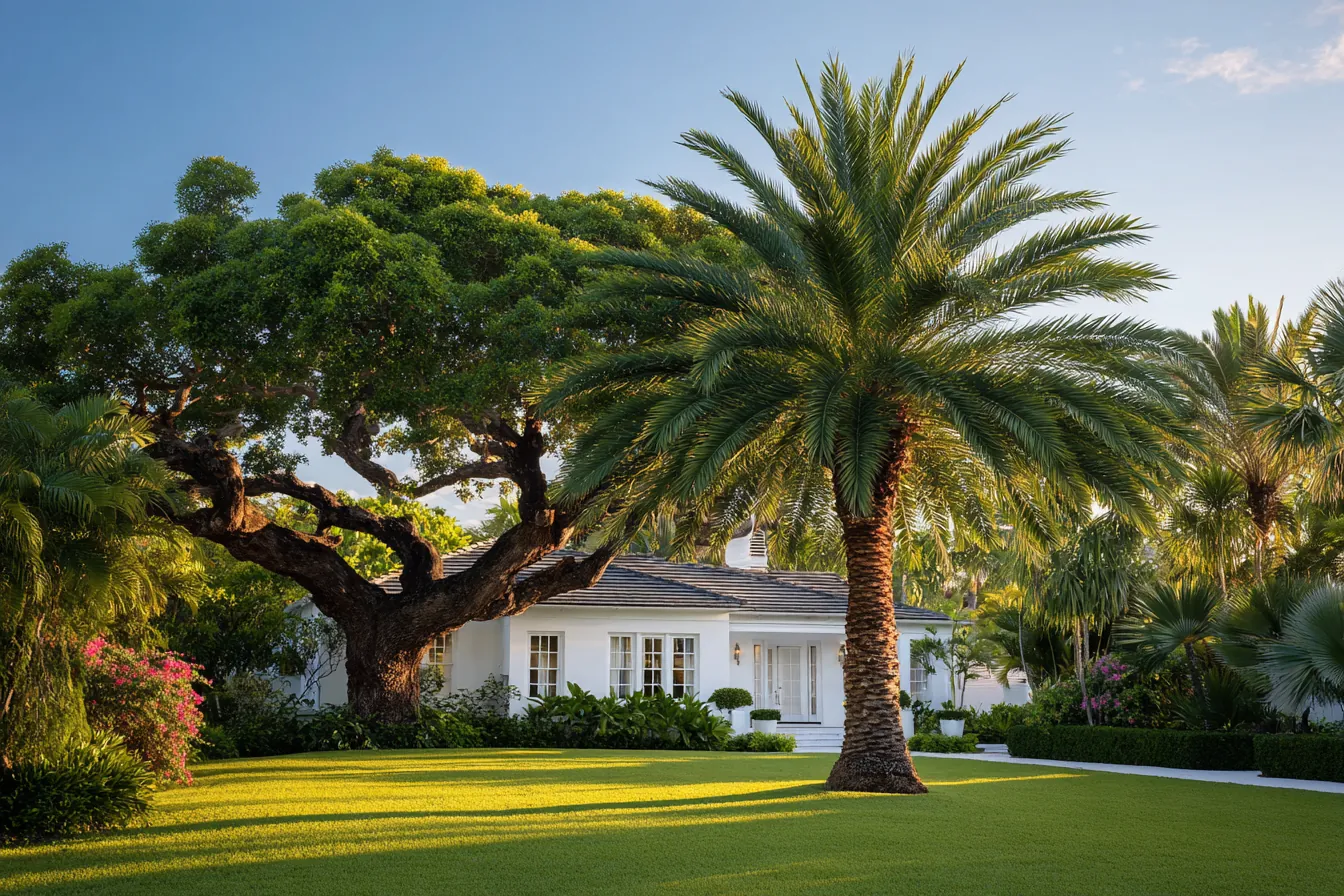
A Naples page that explains the swale-tree permit and a Cape Coral page that shows a 9-to-3 palm cut, with photographs, does something no generic page can. It shows the homeowner you know the rule before you climb.
Tree rules, place by place
One saw. Different rules by county and city.
01 / 06 · Collier County
“A vegetation removal permit for clearing 1 acre or less of land shall not be required for the removal of protected vegetation, other than a specimen tree, on lots subdivided for single-family use”
Single-family lots of an acre or less need no permit, specimen trees aside.
02 / 06 · Unincorporated Lee County
“Lee County exempts most single-family lots of 5 acres or less”
Most single-family lots up to five acres are exempt.
03 / 06 · Lee coastal islands
“which include Gasparilla Island, North Captiva Island, Greater Pine Island and Little Hickory Island”
On these islands, that single-family exemption does not apply.
04 / 06 · City of Naples
“a tree or palm in the public right-of-way between the property line and the street is a city tree, and trimming one needs a $75 tree alteration permit and a qualified contractor”
The swale tree belongs to the city, and trimming it takes a permit.
05 / 06 · Cape Coral palms
“palms may be pruned no wider than a 9:00 to 3:00 pattern”
Palm cuts stay inside a 9 to 3 pattern.
06 / 06 · Cape Coral eagle zones
“Cape Coral bans tree trimming within 1,100 feet of an active nest from October 1 to May 15”
Near an active eagle nest, nesting season stops the trimming.
County lines: US Census Bureau.
05 / 10
Who Can Trim Mangroves in Southwest Florida?
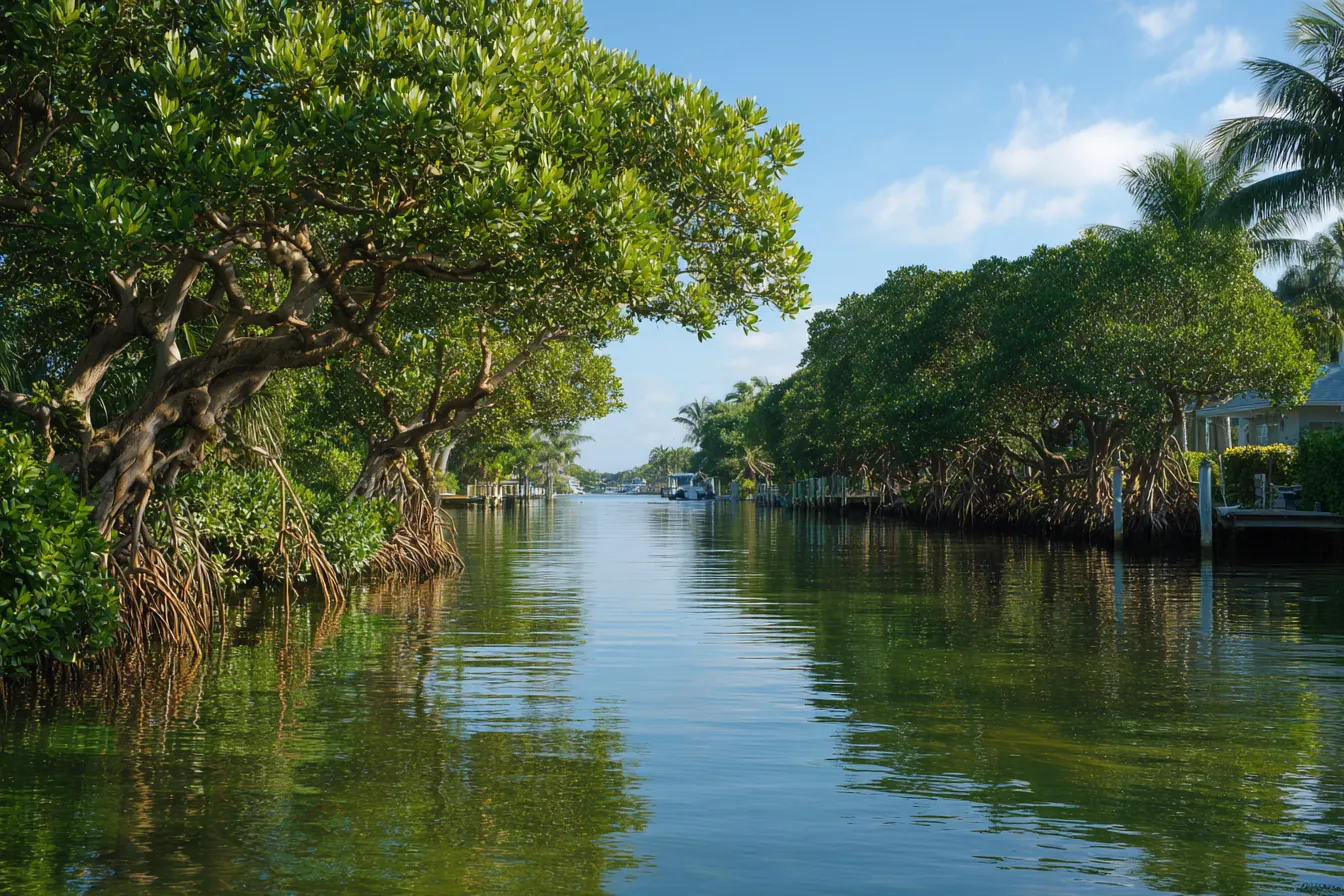
Mangroves run on a state act, not local tree rules. Homeowners may trim their own mangroves only up to 10 feet tall and never below 6 feet (Florida Statutes section 403.9326, 2026), and taller mangroves need a professional mangrove trimmer. An ISA certified arborist qualifies automatically (Florida Statutes section 403.9329, 2026). Collier and Lee are not delegated, so FDEP handles their applications.
The Mangrove Trimming and Preservation Act and any delegated local program "shall be the sole regulations in this state for the trimming and alteration of mangroves on privately or publicly owned lands" (Florida Statutes section 403.9324, 2026). The act covers white, red and black mangroves, and "trim" means "to cut mangrove branches, twigs, limbs, and foliage, but does not mean to remove, defoliate, or destroy the mangroves" (Florida Statutes section 403.9325, 2026).
The homeowner exemption is narrow: the mangroves "may not exceed 10 feet in pretrimmed height as measured from the substrate and may not be trimmed so that the overall height of any mangrove is reduced to less than 6 feet" (Florida Statutes section 403.9326, 2026). For a professional mangrove trimmer the limit rises: the mangroves "may not exceed 24 feet in pretrimmed height," and those "16 feet or greater in pretrimmed height must be conducted in stages so that no more than 25 percent of the foliage is removed annually" (Florida Statutes section 403.9326, 2026).
There are traps for a professional. A trimmer working on red mangroves for the first time under the exemption "must notify the department or delegated local government in writing at least 10 days before commencing the trimming activities," and the exemptions apply to "a shoreline of 150 feet or less," with longer shorelines limited to trimming 65 percent of the mangroves under an exemption (Florida Statutes section 403.9326, 2026). "The use of herbicides or other chemicals for the purposes of removing leaves from a mangrove is strictly prohibited" (Florida Statutes section 403.9328, 2026).
An ISA credential is the shortcut. The statute lists "Certified arborists, certified by the International Society of Arboriculture" as professional mangrove trimmers (Florida Statutes section 403.9329, 2026), and FDEP says that if you qualify, "no further action on your part is required to become a PMT" (Florida DEP professional mangrove trimmer page, 2026). FDEP adds that "Trimming between the months of October and March is most desirable" and that "The trimming exemptions and general permits in the Mangrove Act do not provide for mangrove removal" (Florida DEP mangrove FAQ, 2026).
The penalties land on the trimmer. "The applicant, permittee, landowner, and person performing the trimming are jointly and severally liable for performing restoration," repeat violations can bring "Up to $250 for each mangrove illegally altered," and the state "shall impose a separate penalty upon the professional mangrove trimmer up to $250 for each mangrove illegally trimmed or altered" (Florida Statutes section 403.9332, 2026).
Neither Collier County nor Lee County is on FDEP's list of local governments delegated to run the act, though the City of Sanibel is (Florida DEP mangrove delegation list, 2026), and Collier's own code points mangrove trimming to the state act (Collier County Land Development Code section 3.05, 2026). For waterfront work in Cape Coral, Naples and Bonita Springs, a mangrove page built on those rules is the one a canal homeowner needs, and none of the agency pages we read for the trade covers mangroves at all.
06 / 10
Can a Tree Company Trim Near Power Lines in Florida?
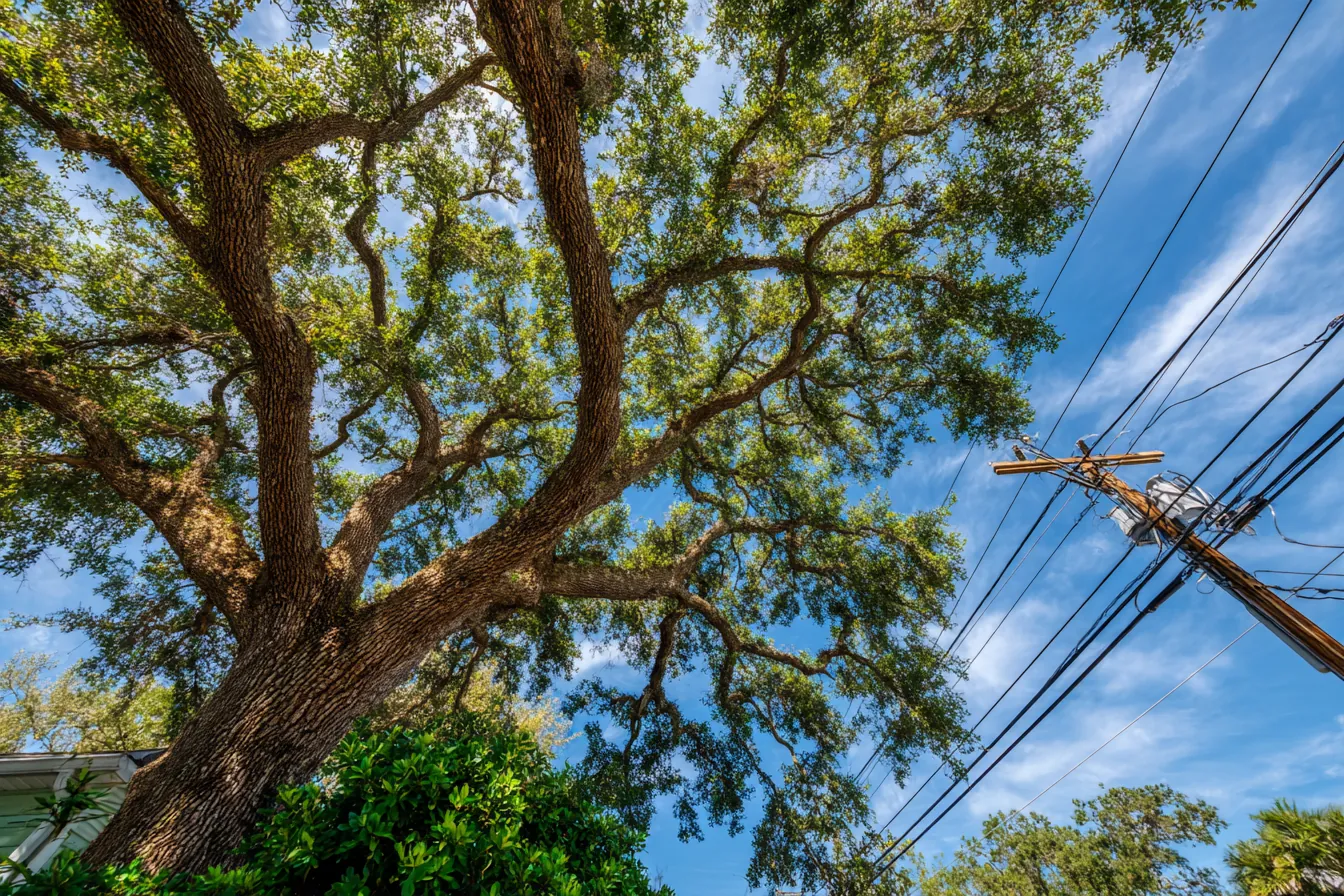
Usually not within 10 feet. OSHA keeps unqualified workers and their tools at least 10 feet from energized overhead lines up to 50 kV (OSHA 29 CFR 1910.333, 2026), and LCEC says only line clearance qualified arborists may work within ten feet of its lines (LCEC vegetation management page, 2026). FPL tells customers to hire a qualified trimmer for trees within 10 feet that FPL does not trim (FPL line clearing page, 2026).
Federal rules split tree work near lines into two worlds. "Line-clearance tree trimming" under 29 CFR 1910.269 covers work within set distances of lines, 10 feet for 50 kV or less, but "Tree trimming performed on behalf of a homeowner or commercial entity other than an organization that operates" power lines "is outside the scope of this section" (OSHA 29 CFR 1910.269, 2026). That residential work falls under the general electrical rules instead.
Those rules are strict. "When an unqualified person is working in an elevated position near overhead lines," the person and the longest conductive object they may contact must stay at least 10 feet away from lines up to 50 kV, and "Any vehicle or mechanical equipment capable of having parts of its structure elevated near energized overhead lines shall be operated so that a clearance of 10 ft. (305 cm) is maintained" (OSHA 29 CFR 1910.333, 2026).
The utilities say the same in plain words. FPL: "FPL will not trim every tree, so it is the customer's responsibility to have the other trees trimmed by a qualified tree trimmer if they are within 10 feet of a power line" (FPL line clearing page, 2026). FPL also tells people to keep themselves and anything they hold "at least 10 feet from main and neighborhood power lines and 30 feet from higher voltage transmission lines" (FPL tree placement page, 2026).
LCEC is blunter: "Per OSHA and ANSI Standards, only line clearance qualified arborists may work within ten feet of electric lines" (LCEC vegetation management page, 2026). It warns that "Very few private tree companies have the knowledge, training, and equipment to be considered line clearance qualified," offers "We may perform the work at no cost to you, or provide safe clearance for you or your contractor," and notes that "LCEC does not maintain trees from the customer service drop" (LCEC vegetation management page, 2026). On palms near lines, LCEC says "The best solution for palms interfering with utility facilities is removal" (LCEC vegetation management page, 2026).
Inside an established utility right-of-way, Florida also bars local permits for the utility's vegetation work, which must be supervised by qualified utility personnel, trained contractors or ISA certified arborists (Florida Statutes section 163.3209, 2026). For a residential tree company, the honest page says what you do near lines, what you leave to FPL or LCEC, and how you coordinate a make-safe. That is a reason to hire you, not a reason to hide the limit.
07 / 10
When Do Bird Nests and Eagle Zones Stop Tree Work?
Federal law makes it unlawful to take a migratory bird's nest or eggs without authorization (Migratory Bird Treaty Act, 2024), and USFWS says destroying an in-use nest requires authorization while an inactive nest can be removed (U.S. Fish and Wildlife Service nest memorandum, 2025). Bald eagles add buffers: Cape Coral bans tree trimming within 1,100 feet of an active nest from October 1 to May 15 (City of Cape Coral Code chapter 23, 2026).
The Migratory Bird Treaty Act makes it unlawful "to pursue, hunt, take, capture, kill, attempt to take, capture, or kill, possess" any migratory bird, including "any part, nest, or egg of any such bird" (Migratory Bird Treaty Act, 2024). USFWS guidance from January 2025 draws the practical line: "An inactive nest can be destroyed without a permit, or other MBTA authorization, provided no person retains possession of the nest or its contents," while "Destruction of an in-use nest requires MBTA authorization," and the agency recommends "conducting activities outside of nesting season" (U.S. Fish and Wildlife Service nest memorandum, 2025). Eagle nests are a separate case.
Florida has, in FWC's words, "one of the densest concentrations of nesting bald eagles in the lower 48 states, with an estimated 1,500 nesting pairs" (Florida Fish and Wildlife Conservation Commission, 2026). State rule says "No person shall take, feed, disturb, possess, sell, purchase or barter any bald eagle or parts thereof, or their nests or eggs" except as USFWS authorizes (Florida Administrative Code Rule 68A-16.002, 2017). The federal guidelines advise avoiding "removal of overstory trees within 330 feet of the nest at any time" and chain saw work during the breeding season within 660 feet, and note that egg laying begins as early as "October in Florida" (U.S. Fish and Wildlife Service bald eagle guidelines, 2007).
Local codes turn that into rules. Lee County defines eagle nesting season as "the period from October 1 to May 15," with buffers that "may range in any distance up to 660 feet from a nest" (Lee County Land Development Code chapter 14, 2026). Cape Coral sets an Eagle Nest Management Zone of "a radius of 1,100 feet" around an active nest, prohibits "tree trimming or tree cutting" inside it during the nesting season, which runs "from October 1 to May 15 for most bald eagles," and says nest trees "shall not be removed, cut, trimmed or otherwise disturbed in any manner at any time" unless the nest has been declared abandoned (City of Cape Coral Code chapter 23, 2026).
Naples will not approve alteration of "any city tree that contains active nests of migratory birds" (City of Naples Code chapter 38, 2026), and Collier's single-family clearing exemption applies only "when there are no bald eagle nests" (Collier County Land Development Code section 3.05, 2026). A tree company that schedules around nesting season, and says so on its site, is selling compliance the customer cannot check for themselves.

08 / 10
Which Credentials Should a Tree Service Website Prove?
In Florida law the credential that matters most is ISA certification: it is named in the hazard-tree statute, the utility right-of-way statute and the mangrove act. ISA requires at least three years of full-time experience to sit for the Certified Arborist credential, and certification lasts three years (International Society of Arboriculture Certified Arborist program guide, 2025). The site should name who holds it.
ISA's program guide says candidates need "a minimum of three years of full-time experience in arboriculture or a combination of education and practical arboricultural experience," with "One year of full-time experience" equal to "approximately 1,795 hours of work" (International Society of Arboriculture Certified Arborist program guide, 2025). The credential "is valid for three (3) years," renewed by exam or by "at least 30 continuing education units (CEUs)" plus a $220 recertification fee (International Society of Arboriculture Certified Arborist program guide, 2025).
Two industry standards matter for the copy. ANSI Z133 "is a United States safety standard for use across the arboriculture industry," and the 2026 edition replaced the one "published in 2017" as of May 27, 2026 (International Society of Arboriculture Z133 page, 2026). ANSI A300, published by TCIA, applies "to professionals who provide for or supervise the management of trees, shrubs, and other woody landscape plants," and its current edition adds "new standards for frond removal" for palms (Tree Care Industry Association, 2025). Naples requires A300 pruning for city trees and Collier names it for required landscape trees, so citing it is not decoration.
Licensing is less clear, and the site should not overclaim. Collier's codified ordinance still defines a "Tree removal and trimming contractor" who "means those who are qualified to trim and remove trees and stumps" (Collier County Code of Ordinances section 22-162, 2026), but we have not confirmed whether the county still issues or requires that card, and we have not confirmed with the state that no arborist license exists. Ask Collier Contractor Licensing before your site makes either claim.
What the site can prove is concrete: each arborist's ISA number and how a homeowner can check it, the insurance behind the work, whether anyone on the crew is line clearance qualified, and photographs of jobs done to the pruning standards the local codes name. A company that writes licensed and insured and stops there gives a homeowner nothing to verify.
Before the season
Trimmed before the storm, not during it.
01 / 05 · After the storm
“The counties want trimming done before storms, not during them.”
02 / 05 · The shade tree, pruned before the season
“Lee County tells residents to do pre-hurricane yard work in March, April and May”
03 / 05 · The yard, cleared and hauled
“Contractors may dispose of debris at the County landfill but must pay applicable disposal fees”
04 / 05 · The palms, cut 9 to 3
“Palms shall only be pruned in such a manner that removal of fronds does not exceed a 9:00 to 3:00 pattern and no more than one-half of the fronds are removed at a single time”
05 / 05 · The page a homeowner reads in May
“A page that explains pre-season trimming, what you haul and what you leave at the curb, and how your price treats disposal is the page a homeowner reads in May, when the work is safest to do and easiest to schedule.”
09 / 10
What Changes for a Tree Service in Hurricane Season?
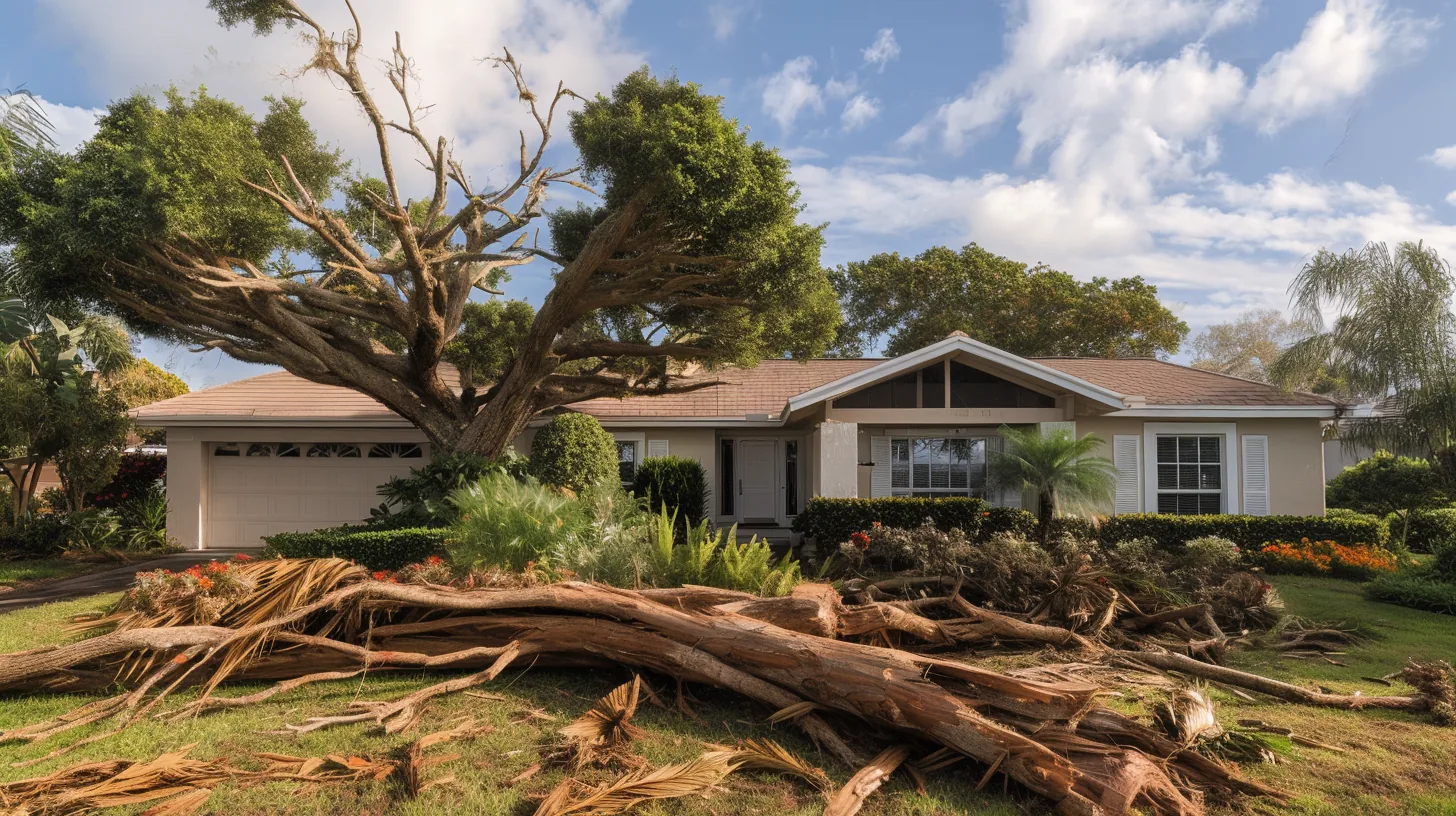
The counties want trimming done before storms, not during them. Lee County tells residents to do pre-hurricane yard work in March, April and May, and once a storm has been named not to cut down trees or do major yard work (Lee County hurricane debris page, 2026). Collier bars contractors from county temporary debris sites and requires them to pay landfill fees (Collier County storm debris FAQ, 2026).
Lee County's guidance is a calendar a tree company can sell against: "Pre-Hurricane Yard Maintenance - perform anytime March, April, May," and once a storm has been named or a watch or warning issued, "Do not cut down trees or do any major yard work," because "Mass cutting produces a burden on the normal collection process" (Lee County hurricane debris page, 2026). After a storm, debris "must be placed in the right of way for collection - collection crews will not enter your private property to remove debris" (Lee County hurricane debris page, 2026).
Collier County is explicit about contractors. "Landscaping contractors may not place non-storm-related debris in the public right-of-way," "Contractors may dispose of debris at the County landfill but must pay applicable disposal fees," "Contractors are not permitted to use County temporary debris management sites," and a contractor may leave storm debris at the curb only "if disposal is not included in the contractor's scope of work or contract price" (Collier County storm debris FAQ, 2026).
Collier's solid waste code adds that trimmings are not county yard trash "if they are collected by a commercial landscape company or other Person that provides lawn and garden maintenance services for remuneration," and curbside yard trash "shall not exceed fifty (50) pounds in weight, four (4) feet in length, or four (4) inches in diameter" (Collier County Code of Ordinances chapter 118, 2026).
Those rules decide how a storm job is quoted. A page that explains pre-season trimming, what you haul and what you leave at the curb, and how your price treats disposal is the page a homeowner reads in May, when the work is safest to do and easiest to schedule.
ChatGPT
Do I need a permit to remove a tree at my house in Florida?
Not if you hold a signed assessment from an ISA certified arborist or a Florida licensed landscape architect that the tree poses an unacceptable risk, and the home is a single-family detached house (Florida Statutes section 163.045, 2026). Otherwise local rules apply, and mangroves follow a separate state act.
Google AI Mode
Can I trim the mangroves behind my house myself?
Only within limits. Homeowners may trim mangroves no taller than 10 feet and never below 6 feet, with no herbicides (Florida Statutes section 403.9326, 2026). Taller mangroves need a professional mangrove trimmer, and an ISA certified arborist qualifies automatically. Removal is not allowed under the exemptions.
Perplexity
Can a tree company trim branches near power lines?
Most cannot work within 10 feet of energized lines. OSHA keeps unqualified workers and equipment 10 feet away from lines up to 50 kV (OSHA 29 CFR 1910.333, 2026), and LCEC says only line clearance qualified arborists may work within ten feet of its lines. Call FPL or LCEC first.
Gemini
Do I need a permit to trim the tree between my sidewalk and the street in Naples?
In the City of Naples, a tree or palm in the public right-of-way is a city tree, and trimming it needs a tree alteration permit, $75, done by a qualified contractor (City of Naples Code chapter 38, 2026). Topping a city tree is prohibited.
Copilot
Can a tree be removed if birds are nesting in it?
An inactive migratory bird nest can be removed without a permit, but destroying an in-use nest requires federal authorization (U.S. Fish and Wildlife Service nest memorandum, 2025). Bald eagle nests are protected separately, and Cape Coral bars tree trimming within 1,100 feet of an active nest from October 1 to May 15 (City of Cape Coral Code chapter 23, 2026).
The answer an engine can quote is the one on your page. These answers are this page’s own.
Tree questions put to AI
Mangroves, power lines and nesting birds.
01 / 05 · Asked in ChatGPT
“Do I need a permit to remove a tree at my house in Florida?”
Reads fromOpenAI’s own search crawler, OAI-SearchBot. OpenAI says it is the bot used to surface websites in ChatGPT’s search answers.
02 / 05 · Asked in Google AI Mode
“Can I trim the mangroves behind my house myself?”
Reads fromThe Google Search index, plus your Google Business Profile.
03 / 05 · Asked in Perplexity
“Can a tree company trim branches near power lines?”
Reads fromIts own index, built by PerplexityBot.
04 / 05 · Asked in Gemini
“Do I need a permit to trim the tree between my sidewalk and the street in Naples?”
Reads fromGoogle’s index, with one extra switch: Google-Extended.
05 / 05 · Asked in Copilot
“Can a tree be removed if birds are nesting in it?”
Reads fromThe Bing index.
10 / 10
What to Build First: Tree Service SEO in Naples and Fort Myers
Start with the risk assessment page under Florida's hazard-tree statute, then a mangrove page, a power line page and a nesting season page. Then one permit page for each place you work, built from that place's code, and service pages for trimming, removal, stump grinding and palms, each with photographs of real jobs and the credential of the person who did the work.
A concrete order of work for a Southwest Florida tree company.
First
the risk assessment page: what the statute allows, who signs, what it costs, and what it does not cover.
Second
the mangrove page for waterfront owners.
Third
the power line page, honest about the 10-foot line.
Fourth
a nesting season page that explains when you will and will not cut.
Then
the places. Naples needs the swale-tree permit and topping ban, and Cape Coral the 9-to-3 palm rule and eagle zones. Unincorporated Lee County near Fort Myers has the 5-acre single-family exemption and its coastal island exception, while the City of Fort Myers and Bonita Springs have their own codes, which we read before writing those pages rather than borrowing the county's.
Then
the service pages: trimming, removal, stump grinding, palm trimming and storm cleanup, kept separate because they are separate searches, and each tied to real jobs. A complete Business Profile with the same photographs and steady reviews confirm what the site claims. If you also run a landscape crew, the landscaping guide covers that side.
If you would rather have this built and maintained than written between jobs, that is what we do, month to month, from Naples.
Estimate it
What might SEO cost and take for you?
Three questions, an honest range. This uses real Southwest Florida market rates and observed timelines, not a canned package price. It is an estimate to orient you, never a quote. The real number comes from a free audit of your actual site.
1 · HOW COMPETITIVE IS YOUR MARKET?
2 · WHERE IS YOUR SITE TODAY?
3 · WHAT ARE YOU AFTER?
ILLUSTRATIVE ESTIMATE
TYPICAL MONTHLY INVESTMENT
$1,700 – $3,100
/ month · month-to-month
TIME TO MEANINGFUL RESULTS
3 – 6 months
map pack movement, then attributed leads
Estimate from Southwest Florida market rates. Not a quote. Your audit sets the actual scope and price.
Watch it work
Turn on what makes AI recommend you.
AI recommends the businesses it can read, trust and quote. Flip on the four signals we engineer, and watch your visibility climb and the answer rewrite itself.
THE FOUR SIGNALS WE ENGINEER
Illustrative · the four signals are the real system we build
Questions
What tree service, arborist and palm trimming companies ask us first.
Jamie Kloncz · SEO Elite Agency, Naples
Not if you hold a signed assessment from an ISA certified arborist or a Florida licensed landscape architect that the tree poses an unacceptable risk, and the home is a single-family detached house (Florida Statutes section 163.045, 2026). Otherwise local rules apply, and mangroves follow a separate state act.
Jamie Kloncz · SEO Elite Agency, Naples
Only within limits. Homeowners may trim mangroves no taller than 10 feet and never below 6 feet, with no herbicides (Florida Statutes section 403.9326, 2026). Taller mangroves need a professional mangrove trimmer, and an ISA certified arborist qualifies automatically. Removal is not allowed under the exemptions.
Jamie Kloncz · SEO Elite Agency, Naples
Most cannot work within 10 feet of energized lines. OSHA keeps unqualified workers and equipment 10 feet away from lines up to 50 kV (OSHA 29 CFR 1910.333, 2026), and LCEC says only line clearance qualified arborists may work within ten feet of its lines. Call FPL or LCEC first.
Jamie Kloncz · SEO Elite Agency, Naples
In the City of Naples, a tree or palm in the public right-of-way is a city tree, and trimming it needs a tree alteration permit, $75, done by a qualified contractor (City of Naples Code chapter 38, 2026). Topping a city tree is prohibited.
Jamie Kloncz · SEO Elite Agency, Naples
An inactive migratory bird nest can be removed without a permit, but destroying an in-use nest requires federal authorization (U.S. Fish and Wildlife Service nest memorandum, 2025). Bald eagle nests are protected separately, and Cape Coral bars tree trimming within 1,100 feet of an active nest from October 1 to May 15 (City of Cape Coral Code chapter 23, 2026).
Jamie Kloncz · SEO Elite Agency, Naples
No. SEO Elite Agency works month-to-month from our Naples office at 1950 Mayfair Street, Suite 313. Long contracts protect agencies from their own results, and we would rather earn the next month. Reach us at (843) 955-7727 or [email protected].
Sources
- Google Keyword Planner: Ft. Myers-Naples FL DMA, October 2025 to September 2026, read by SEO Elite Agency October 15 2026 - tree service 260 (bid to $41.40), stump grinding 260, tree trimming 210 (three-month +179%, year over year +22%), arborist 170, tree removal 140 (three-month +86%, year over year +53%, bid to $87.82), palm tree trimming 90
- Florida Statutes section 163.045: 2026 edition (history through ch. 2022-121), read October 15 2026 - no local permit, fee or mitigation with a signed ISA arborist or landscape architect assessment of unacceptable risk; single-family detached homes; no replanting; mangroves excluded
- Florida Statutes section 163.3209: 2026 edition, read October 15 2026 - no local permits for vegetation maintenance in an established electric utility right-of-way; supervision by qualified utility personnel, trained contractors or ISA certified arborists
- Florida Statutes section 403.9324: 2026 edition, read October 15 2026 - the Mangrove Trimming and Preservation Act and delegated programs are the sole mangrove trimming regulations
- Florida Statutes section 403.9325: 2026 edition, read October 15 2026 - definitions of mangrove and trim
- Florida Statutes section 403.9326: 2026 edition, read October 15 2026 - homeowner and professional mangrove trimmer exemptions; 10, 16 and 24 foot thresholds; 150-foot shoreline limit; 10-day notice for red mangroves
- Florida Statutes section 403.9328: 2026 edition, read October 15 2026 - herbicide defoliation of mangroves prohibited
- Florida Statutes section 403.9329: 2026 edition, read October 15 2026 - ISA certified arborists are professional mangrove trimmers
- Florida Statutes section 403.9332: 2026 edition (history through ch. 2024-144), read October 15 2026 - joint and several restoration liability; per-tree fines; separate penalty on the professional mangrove trimmer
- Florida DEP professional mangrove trimmer page: How to Become a Professional Mangrove Trimmer, last modified September 2 2026, read October 15 2026 - qualifying persons need take no further action
- Florida DEP mangrove FAQ: Mangrove Frequently Asked Questions, last modified June 11 2026, read October 15 2026 - October to March most desirable; exemptions do not allow removal
- Florida DEP mangrove delegation list: Mangrove Trimming Delegated Local Governments, last modified June 11 2026, read October 15 2026 - seven delegations, among them the City of Sanibel; neither Collier County nor Lee County is listed
- Collier County Land Development Code section 3.05: vegetation removal, sections 3.05.01 to 3.05.05 (Municode Supplement 34, 2026), read October 15 2026 - vegetation removal permit; single-family exemption only when there are no bald eagle nests; 180-day permit; mangrove trimming left to the state
- Collier County Land Development Code section 4.06.05: landscape maintenance (Municode Supplement 34, 2026), read October 15 2026 - no severe pruning of required trees; ANSI A300 named
- Collier County Code of Ordinances section 22-162: contractor definitions (Municode Supplement 127, 2026), read October 15 2026 - tree removal and trimming contractor defined
- City of Naples Code chapter 38: tree protection, sections 38-2, 38-4, 38-6, 38-105, 38-106, 38-123 (Municode Supplement 74, 2026), read October 15 2026 - city trees include right-of-way trees and palms; tree alteration permit; topping and hatracking banned; ISA certified arborist and ANSI A300 for city trees; penalties
- City of Naples Fees and Charges Schedule: Code of Ordinances Appendix A (Municode Supplement 74, 2026), read October 15 2026 - tree alteration permit $75
- Lee County Land Development Code chapter 14: tree protection sections 14-375 to 14-380 and eagle definitions section 14-112 (Municode Supplement 3 Update 3, 2026), read October 15 2026 - single-family 5-acre exemption except listed coastal islands; Appendix E species; $500 per violation; 30-day emergency suspension; nesting season October 1 to May 15
- City of Cape Coral Land Development Code section 5.5.16: landscape maintenance (Municode Supplement 38, 2026), read October 15 2026 - palm pruning limited to a 9:00 to 3:00 pattern; certified arborist on sites over one acre
- City of Cape Coral Code chapter 23: bald eagle protection, sections 23-2 and 23-5 (Municode Supplement 38, 2026), read October 15 2026 - 1,100-foot Eagle Nest Management Zone; no tree trimming or cutting in nesting season
- City of Cape Coral Code section 9-18: residue removal (Municode Supplement 38, 2026), read October 15 2026 - tree surgeons must remove their residue
- OSHA 29 CFR 1910.269: electric power generation, transmission and distribution (eCFR as of October 14 2026), read October 15 2026 - line-clearance tree trimming definition; homeowner tree trimming outside its scope
- OSHA 29 CFR 1910.333: selection and use of work practices (eCFR as of October 14 2026), read October 15 2026 - unqualified persons and elevated equipment kept 10 feet from lines up to 50 kV
- FPL line clearing page: Florida Power & Light, read October 15 2026 - customer responsible for a qualified trimmer within 10 feet of lines FPL does not trim
- FPL tree placement page: Florida Power & Light, read October 15 2026 - keep 10 feet from neighborhood lines and 30 feet from transmission lines
- LCEC vegetation management page: Lee County Electric Cooperative vegetation management and tree trimming request pages, read October 15 2026 - only line clearance qualified arborists within ten feet; no-cost work or safe clearance; service drop not maintained; palms near lines best removed
- Migratory Bird Treaty Act: 16 U.S.C. 703(a), United States Code 2024 Edition (govinfo), read October 15 2026
- U.S. Fish and Wildlife Service nest memorandum: MBPM-2-02, January 15 2025, read October 15 2026 - inactive nests may be destroyed without a permit; in-use nests need authorization; eagle nests excepted
- U.S. Fish and Wildlife Service bald eagle guidelines: National Bald Eagle Management Guidelines, May 2007, read October 15 2026 - 330 and 660 foot recommendations; Florida egg laying from October
- Florida Fish and Wildlife Conservation Commission: bald eagle page, read October 15 2026 - about 1,500 nesting pairs in Florida; continued federal and state protection
- Florida Administrative Code Rule 68A-16.002: bald eagle rule, effective June 22 2017, read October 15 2026
- International Society of Arboriculture Certified Arborist program guide: revised August 2025, read October 15 2026 - three years of experience; three-year certification; 30 CEUs and $220 recertification
- International Society of Arboriculture Z133 page: Z133-2026 publication page, read October 15 2026 - US arboricultural safety standard; 2026 edition replaced the 2017 edition on May 27 2026
- Tree Care Industry Association: ANSI A300 Standards page (modified November 18 2025), read October 15 2026 - A300 scope; palm frond removal standards
- Lee County hurricane debris page: Lee County Solid Waste, Hurricane and Disaster Debris Management, read October 15 2026 - pre-hurricane yard maintenance March to May; no major cutting once a storm is named; debris in the right of way
- Collier County storm debris FAQ: Storm-Related Debris FAQ (file dated January 5 2026), read October 15 2026 - contractor restrictions on right-of-way debris and county temporary sites; curbside only if disposal is outside the contract price
- Collier County Code of Ordinances chapter 118: solid waste, sections 118-86 and 118-104 (Municode Supplement 127, 2026), read October 15 2026 - trimmings from paid services are not county yard trash; 50 pound, 4 foot, 4 inch limits
Keep reading
Written by Jamie Kloncz, founderSEO Elite Agency, Naples FL. Last updated .
Start with the audit.
About 60 seconds, no email, and you get named findings for your own site, not a score out of a hundred.