HOME ELEVATORS · SEO SERVICES
Home Elevator Company SEO for Raised Homes in Southwest Florida
Home elevator company SEO in Southwest Florida is about a buyer with a specific problem: a house raised a story or more above the ground to meet flood rules, and a family member who cannot climb the stairs. That buyer asks who regulates a home elevator, what the flood rules allow below the house and what insurance will cover. The company that answers those questions plainly is the one they call.
 Jamie Kloncz, founder. Does the work himself, from Naples.
★★★★★ 5.0 on GoogleNaples, FloridaMonth to month
In one paragraph
Home elevator company SEO is the work of making a residential elevator, platform lift and stair lift company the most credible search and AI answer for homeowners adding access to a raised or multi-story home, built on Florida's elevator law, the Max Grablin Act, the building code and the flood rules of the places it works. SEO Elite Agency builds that for home elevator companies across Naples and Southwest Florida, month to month, starting with a free audit.
01 / 10
How Many People Search for Home Elevators in Naples and Fort Myers?
In the Ft. Myers-Naples market, "residential elevator" averaged 140 Google searches a month, "home elevator" 90, "stair lift" 40 and "elevator company" 20 (Google Keyword Planner, 2026). That is about 290 searches a month, a small market where each job is large, and "residential elevator" carried a top-of-page bid as high as $27.90 (Google Keyword Planner, 2026).
We read these numbers ourselves in Google Keyword Planner on October 15, 2026, for the Ft. Myers-Naples DMA, covering October 2025 through September 2026.
Small volume is not a reason to skip the trade. "Residential elevator" rose 29 percent over the latest three months (Google Keyword Planner, 2026). In a market this size, the company with the clearest answers to a handful of questions has a real chance to lead the results.
The person searching may not be the person who will ride the elevator: an adult child may search for a parent, and an architect or builder may be asked for a name. That favors pages that explain rather than pitch: who regulates the equipment, what the flood rules require, what it costs to own, and what happens after a storm.
Elevator searches in Ft. Myers-Naples
A small market, measured.
Average searches a month. Google Keyword Planner, Ft. Myers-Naples FL DMA, October 2025 to September 2026, read October 15, 2026.
- “That is about 290 searches a month, a small market where each job is large”
- “"residential elevator" carried a top-of-page bid as high as $27.90”
- “"Residential elevator" rose 29 percent over the latest three months”
02 / 10
Does Florida Regulate Home Elevators?
Not the way it regulates commercial elevators. Florida's Elevator Safety Act lists elevators, inclined stairway chairlifts and wheelchair lifts "located in private residences" among equipment not covered by the chapter (Florida Statutes section 399.02, 2026), and they need no state certificate of operation (Florida Statutes section 399.03, 2026). The state bureau says it does not regulate or license them.
The statute is direct. Under the heading "Equipment not covered by this chapter includes, but is not limited to," it lists "(u) Elevators, inclined stairway chairlifts, and inclined or vertical wheelchair lifts located in private residences" (Florida Statutes section 399.02, 2026). It defines a private residence as "a separate dwelling or a separate apartment in a multiple dwelling which is occupied by members of a single-family unit" (Florida Statutes section 399.01, 2026).
The certificate rule follows: "Vertical conveyances, including stairway chairlifts, and inclined or vertical wheelchair lifts located in private residences are not required to obtain a certificate of operation under this chapter," and the inspection requirement applies to every vertical conveyance "except those in a private residence" (Florida Statutes section 399.03, 2026). The state bureau puts it plainly: "Conveyances located in and serving only one family residence are not regulated by the division and do not require a permit from the division," and "The division does not license conveyances in private residences" (Florida DBPR Bureau of Elevator Safety permits page, 2026).
One sentence complicates the picture, and an honest site should not paper over it. The same subsection opens "All new conveyance installations must be performed by a registered elevator company" (Florida Statutes section 399.03, 2026), with no residential carve-out in that sentence. Whether that reaches a home install, given the exclusion above, is not settled by the text, and we would not tell a homeowner either way without a written answer from the Bureau of Elevator Safety.
For marketing, the useful line is this: the state permit, certificate of operation and inspection system does not apply to a single-family home, so the homeowner is relying on your company, your installer and the building code instead. That is a reason to explain your standards in detail, not a reason to say less.
03 / 10
What Does the Max Grablin Act Require of a Home Elevator?
Florida's Max Grablin Act "applies to all new elevators in a private residence" (Florida Statutes section 399.031, 2026). It caps the gap between the hoistway door and the landing sill at 3/4 inch for swinging doors and 2 1/4 inches for sliding doors, and requires a master-key reset after a door lock opens outside the unlocking zone (Florida Statutes section 399.031, 2026).
The text is short. Its short title is the Maxwell Erik Max Grablin Act, and subsection (4) says "This section applies to all new elevators in a private residence" (Florida Statutes section 399.031, 2026). The gap limits apply between the hoistway face of the doors and the hoistway edge of the landing sill: no more than 3/4 inch for swinging doors and 2 1/4 inches for sliding doors (Florida Statutes section 399.031, 2026).
Where a folding door is used, "the space between the hoistway door and the folding door must reject a 4-inch-diameter sphere at all points" (Florida Statutes section 399.031, 2026). And if a landing door lock is opened away from the unlocking zone, the controller "must not allow the elevator car to restart until the owner or the owner's agent, with a master elevator key, has checked for obstructions above and below the elevator car" (Florida Statutes section 399.031, 2026).
The building code carries the same rules. The 2023 Florida Building Code, Residential, says private residence elevators "shall comply with ASME A17.1/CSA B44" and platform lifts "shall comply with ASME A18.1," and its R321.4 repeats the door clearance rules (Florida Building Code Residential chapter 3, 2023). The Building volume repeats them as well (Florida Building Code Building chapter 30, 2023).
This is the page a parent of young children reads. A company that explains the gap limits, shows how its doors meet them, and walks the owner through the master-key reset is answering the safety question before it is asked. It is also the clearest way to show you install to Florida's rule rather than a generic national spec.
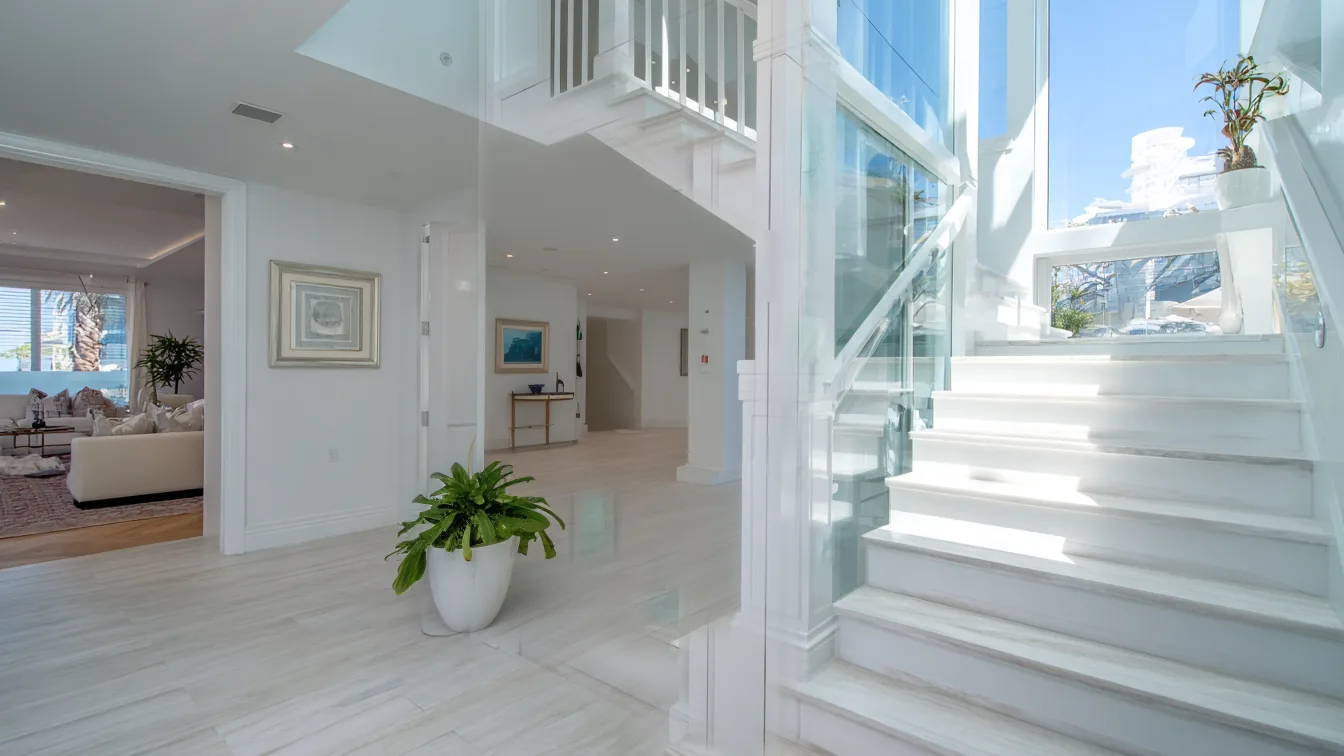
The Max Grablin Act, installed
One foyer. One new elevator.
01 / 05 · Stairs only, for now
“The person searching may not be the person who will ride the elevator”
02 / 05 · The landing door gap
“no more than 3/4 inch for swinging doors and 2 1/4 inches for sliding doors”
03 / 05 · The master-key reset
“must not allow the elevator car to restart until the owner or the owner's agent, with a master elevator key, has checked for obstructions above and below the elevator car”
04 / 05 · Built to ASME A17.1
“private residence elevators "shall comply with ASME A17.1/CSA B44"”
05 / 05 · Installed to Florida’s rule
“It is also the clearest way to show you install to Florida's rule rather than a generic national spec.”
04 / 10
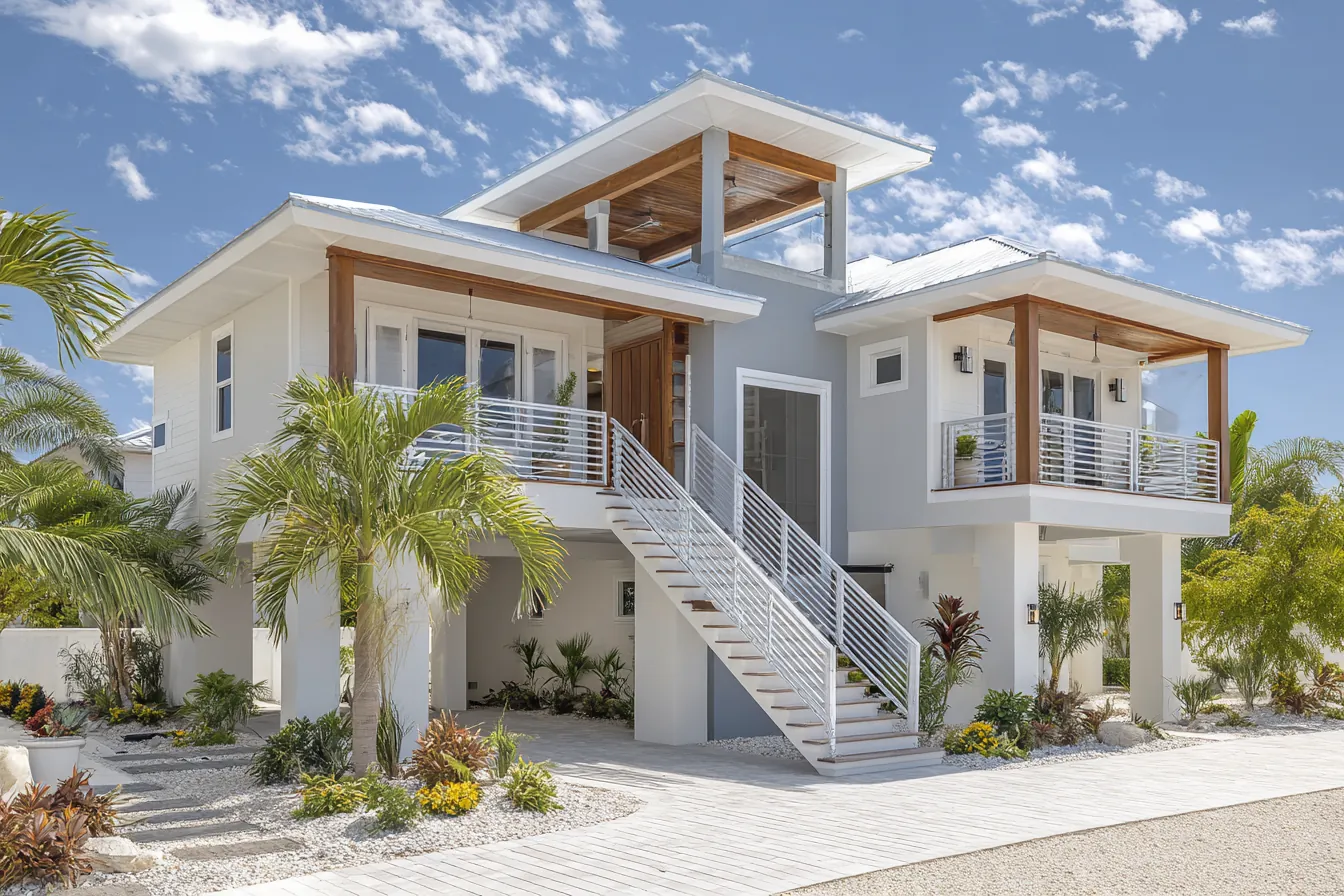
Where Can an Elevator Go Below a Raised Home in a Flood Zone?
Below the required elevation, the residential code limits enclosed areas to parking, building access or storage, and exempts elevator shafts from the flood-opening and breakaway-wall rules (Florida Building Code Residential chapter 3, 2023). FEMA's elevator bulletin adds that a float switch is required wherever the cab could descend below the base flood elevation (FEMA Technical Bulletin 4, 2019).
The code text is specific. Enclosed areas below the required elevation must "Be used solely for parking of vehicles, building access or storage," and for both the flood-opening and breakaway-wall rules, the code lists "Elevator shafts" as an exception (Florida Building Code Residential chapter 3, 2023). FEMA says the same in plain words: "Elevators, just as stairs and ramps, are permitted for building access" (FEMA Technical Bulletin 4, 2019).
Equipment placement is the harder part. The code requires electrical and other service equipment to "be located at or above the elevation required" unless designed to keep water out (Florida Building Code Residential chapter 3, 2023), the federal flood rule says the same for service facilities (Code of Federal Regulations 44 CFR 60.3, 2026), and the Building code adds that elevators in flood hazard areas must conform to "ASCE 24 for construction in flood hazard areas" (Florida Building Code Building chapter 30, 2023).
FEMA's bulletin turns that into design advice. "A float switch system or another system that provides the same level of safety is required, per ASME A17.1, for all elevators where there is a potential for the elevator cab to descend below the BFE during flood conditions" (FEMA Technical Bulletin 4, 2019). It says "the designated floor must be located above the BFE," that electrical equipment in the hoistway below the BFE "should be inside a National Electrical Manufacturers Association (NEMA) 4-rated enclosure," and that "holeless hydraulic elevators are recommended for low-rise buildings" (FEMA Technical Bulletin 4, 2019).
Two more lines fit Southwest Florida closely. FEMA notes that retrofit elevators "are usually installed in a shaft that is exterior to an original outside wall," and that "when platform lifts are installed outdoors, it can be more difficult to elevate equipment above the BFE, making it susceptible to flood damage" (FEMA Technical Bulletin 4, 2019). Florida's building code adds its own rule for in-ground hydraulics: new underground cylinders "shall be encased in outer plastic containment to minimize electrolytic corrosion" (Florida Building Code Building chapter 30, 2023).
05 / 10
Does Flood Insurance Cover a Home Elevator?
Often not the parts that flood. FEMA says the NFIP "does not cover elevator-related equipment located below the lowest floor of elevated buildings constructed after the community joined the NFIP or installed below the BFE after September 30, 1987" (FEMA Technical Bulletin 4, 2019). It also says there is a premium surcharge when the elevator pit is below the BFE.
The full surcharge line reads "There is a premium surcharge for elevators in an SFHA if the elevator pit is below the BFE, whether the pit is below grade or not" (FEMA Technical Bulletin 4, 2019). For a homeowner comparing designs, that means pit depth and equipment location are cost questions as well as code questions.
The tax side is narrower than many buyers hope. IRS Publication 502 lists "Installing porch lifts and other forms of lifts (but elevators generally add value to the house)" among capital expenses (IRS Publication 502, 2025). It explains that "The cost of the improvement is reduced by the increase in the value of your property," and that "The difference is a medical expense" (IRS Publication 502, 2025). We found no Florida sales tax exemption that names elevators or lifts, so a site should not promise one.
A page that explains these trade-offs honestly, with the source for each, is worth more to a buyer than a brochure. Recommend that owners confirm coverage with their own agent, and say exactly where your designs put the controller, the pump and the float switch.
06 / 10
What Did Hurricane Ian Show About Elevators in Elevated Buildings?
FEMA's Hurricane Ian team found that newer elevated buildings had minor flood damage, but at a Lee County fire station, "equipment in the hydraulic elevator pit was extensively damaged and required replacement" (FEMA Hurricane Ian Mitigation Assessment Team Report, 2023). The same report records that Fort Myers limits partitions below elevated buildings to stairwells, ramps, elevators and fire-code partitions.
The Ian report notes that "newer buildings elevated above ground had minor flood damage that was limited primarily to contents and non-flood damage" (FEMA Hurricane Ian Mitigation Assessment Team Report, 2023), which is the case for building up. The fire station finding shows what a flooded pit costs even when the rest of the building does well.
Local rules shape the space under the house. FEMA records that "Fort Myers, in Chapter 102, Article III of its Land Development Code, has limitations on enclosure areas that limit the installation of partitions to those for stairwells, ramps, and elevators and those required by the fire code" (FEMA Hurricane Ian Mitigation Assessment Team Report, 2023). The City of Naples code says enclosed areas below the required elevation "shall not be partitioned or finished into separate rooms except for small mechanical rooms and stairwells, ramps, and elevators unless a partition is required by the fire code" (City of Naples Code section 16-112, 2026).
Collier County's fee schedule, effective January 1, 2026, lists a "Hydraulic elevator shaft permit" at $300 under its well permits (Collier County fee schedule Resolution 2025-231, 2025). We did not find a separate residential elevator permit type on the Collier, Lee or Cape Coral pages we read, so each local page should be built from what that building department tells you in writing.
Below the raised house, place by place
The state steps back. Local rules shape the space below.
01 / 06 · Statewide
“Conveyances located in and serving only one family residence are not regulated by the division and do not require a permit from the division”
A one-family home elevator sits outside the state permit system.
02 / 06 · Fort Myers
“Fort Myers, in Chapter 102, Article III of its Land Development Code, has limitations on enclosure areas that limit the installation of partitions to those for stairwells, ramps, and elevators and those required by the fire code”
Under a raised home, partitions are limited to stairwells, ramps, elevators and fire-code walls.
03 / 06 · Lee County, after Ian
“equipment in the hydraulic elevator pit was extensively damaged and required replacement”
At one fire station, a flooded hydraulic pit meant replacing its equipment.
04 / 06 · Naples
“shall not be partitioned or finished into separate rooms except for small mechanical rooms and stairwells, ramps, and elevators unless a partition is required by the fire code”
Below the required elevation, elevators are among the few partitions allowed.
05 / 06 · Collier County
“lists a "Hydraulic elevator shaft permit" at $300 under its well permits”
The county fee schedule files the hydraulic shaft under well permits, at $300.
06 / 06 · Cape Coral and Bonita Springs
“Cape Coral and Bonita Springs have their own building departments, so their pages start from what those departments say, not from the county's rules.”
Each city page starts from its own building department.
County lines: US Census Bureau.
07 / 10
Which Elevator Credentials Should a Florida Company Show?
Florida defines a "registered elevator company" that must register annually and carry liability insurance, and a "certified elevator technician" who holds an elevator certificate of competency (Florida Statutes section 399.01, 2026). Falsely claiming a credential under the chapter is a second-degree misdemeanor (Florida Statutes section 399.11, 2026), so a website should name each credential exactly.
The statute defines a registered elevator company as "an entity registered with and authorized by the division employing persons to construct, install, inspect, maintain, or repair any vertical conveyance" (Florida Statutes section 399.01, 2026). The rule sets its insurance: "A registered elevator company must maintain general liability insurance coverage in the minimum amounts of $100,000 per person and $300,000 per occurance," and it must list at least one employee who "holds a current certificate of competency" (Florida Administrative Code Rule 61C-5.007, 2021).
The individual credential takes experience. The certificate of competency requires "Four years' work experience in the construction, maintenance, service, and repair of conveyances covered by this chapter," costs $50, lasts one year and renews with 8 hours of continuing education (Florida Statutes section 399.01, 2026). The rule adds that "the certificate of competency is a credential only and does not authorize any work to be performed" on its own (Florida Administrative Code Rule 61C-5.007, 2021).
Misstating it is a crime: "Any person who falsely represents himself or herself as credentialed under this chapter is guilty of a misdemeanor of the second degree" (Florida Statutes section 399.11, 2026). A site that writes licensed and certified without saying by whom invites the obvious question. Print the registration and certificate numbers and link to the state lookup.
08 / 10
What Changes When a Lift Is in a Condo, Church or Clinic?
Outside private residences the state rules apply in full. The chapter covers equipment that "includes, but is not limited to, elevators, platform lifts, and stairway chairlifts" (Florida Statutes section 399.02, 2026), a state permit is required before installation, and DBPR's rule sets the install permit fee at $250 plus the certificate of operation fee (Florida Administrative Code Rule 61C-5.006, 2026).
For covered work, "A conveyance covered by this chapter may not be erected, constructed, installed, or altered within buildings or structures until a permit has been obtained from the department," and "Permits must be applied for by a registered elevator company" (Florida Statutes section 399.03, 2026). DBPR advises that "for planning purposes please allow 3-4 weeks for processing" (Florida DBPR Bureau of Elevator Safety permits page, 2026).
Florida adopted ASME A17.1-2019 "with the following exclusions," including "Private Residence Elevators: 5.3," and adopted "ASME A18.1-2020, Safety Standard for Platform Lifts and Stairway Chairlifts" (Florida Administrative Code Rule 61C-5.001, 2026). DBPR contracts some regulatory work to local jurisdictions, but its list names City of Miami, Miami Beach, Miami-Dade, Broward and the Central Florida Tourism Oversight District, and says "All elevator professionals must apply with the State" (Florida DBPR contracted jurisdictions page, 2026).
Small commercial buildings bring recurring work. "If the elevator is not an escalator or a dumbwaiter, serves only two adjacent floors, and is covered by a service maintenance contract, an inspection is not required so long as the service contract remains in effect" (Florida Statutes section 399.061, 2026). Working without a required permit can bring "an administrative fine not greater than $1,000" (Florida Statutes section 399.105, 2026).
A company that serves both homes and small buildings should keep those pages apart. The rules, the buyer and the paperwork are different, and mixing them confuses both.
Which state rules reach this lift
A private home, or a covered building?
Local building rules still apply, so ask your building department what it requires for your address.
Where is the elevator or lift?
What is going into the home?
Is it a new install or alteration, or an existing elevator?
Does it serve only two adjacent floors under a service maintenance contract, and is it not an escalator or dumbwaiter?
The Max Grablin Act applies to every new home elevator
“This section applies to all new elevators in a private residence”
No state certificate of operation for a home lift
“Vertical conveyances, including stairway chairlifts, and inclined or vertical wheelchair lifts located in private residences are not required to obtain a certificate of operation under this chapter”
A state permit comes before the work
“A conveyance covered by this chapter may not be erected, constructed, installed, or altered within buildings or structures until a permit has been obtained from the department”
No inspection while the service contract holds
“If the elevator is not an escalator or a dumbwaiter, serves only two adjacent floors, and is covered by a service maintenance contract, an inspection is not required so long as the service contract remains in effect”
Inspection reaches every conveyance outside a home
“the inspection requirement applies to every vertical conveyance "except those in a private residence"”
09 / 10
What Should a Home Elevator Company Website Prove?
Five things a buyer can check: the Max Grablin Act door rules and how your doors meet them, the flood design for raised homes, what insurance does and does not cover, the credentials of the company and its technicians, and real installs in homes like theirs. FEMA's flood guidance names elevators as permitted building access (FEMA Technical Bulletin 4, 2019), so explain the design.
Start with safety, because that is what the family is worried about. A page on the Max Grablin Act, with a diagram of your door gaps and a short video of the master-key reset, does more than any testimonial.
Then the flood page for elevated homes: where the pit, pump and controller sit, how the float switch works, where the car parks in a storm, and why. Then an honest cost-of-ownership page that covers the NFIP exclusion, the pit surcharge and the IRS rule on lifts and elevators, each with its source.
Then the credentials page and the project pages: real installs in real neighborhoods, the shaft location, the drive type and the photographs. A complete Business Profile with the same photographs and steady reviews confirm what the site claims.
ChatGPT
Does a home elevator need a state permit in Florida?
No state certificate of operation is required for elevators and lifts in private residences, and the state lists them as equipment not covered by its elevator chapter (Florida Statutes section 399.02, 2026). Local building rules still apply, so ask your building department what it requires for your address.
Google AI Mode
What is the Max Grablin Act?
A Florida law that applies to all new elevators in a private residence. It limits the gap at the landing sill to 3/4 inch for swinging doors and 2 1/4 inches for sliding doors, and requires a master-key reset after a door lock opens outside the unlocking zone (Florida Statutes section 399.031, 2026).
Perplexity
Can my elevator pit be below the flood elevation?
Elevator shafts are allowed below a raised home, but FEMA says a float switch is required where the cab could descend below the base flood elevation, the designated floor must be above it, and a pit below it carries a flood insurance surcharge (FEMA Technical Bulletin 4, 2019).
Gemini
Will flood insurance pay to repair my elevator?
Often not for equipment below the lowest floor. FEMA says the NFIP does not cover elevator-related equipment below the lowest floor of post-FIRM elevated buildings or installed below the BFE after September 30, 1987 (FEMA Technical Bulletin 4, 2019). Confirm your policy with your agent.
Copilot
Is a home elevator tax deductible?
Possibly in part. IRS Publication 502 treats lifts as a medical capital expense but notes that elevators generally add value to the house, and only the cost above the increase in property value counts (IRS Publication 502, 2025). Ask a tax professional about your situation.
The answer an engine can quote is the one on your page. These answers are this page’s own.
Elevator questions in AI answers
Permits, pits and the Max Grablin Act.
01 / 05 · Asked in ChatGPT
“Does a home elevator need a state permit in Florida?”
Reads fromOpenAI’s own search crawler, OAI-SearchBot. OpenAI says it is the bot used to surface websites in ChatGPT’s search answers.
02 / 05 · Asked in Google AI Mode
“What is the Max Grablin Act?”
Reads fromThe Google Search index, plus your Google Business Profile.
03 / 05 · Asked in Perplexity
“Can my elevator pit be below the flood elevation?”
Reads fromIts own index, built by PerplexityBot.
04 / 05 · Asked in Gemini
“Will flood insurance pay to repair my elevator?”
Reads fromGoogle’s index, with one extra switch: Google-Extended.
05 / 05 · Asked in Copilot
“Is a home elevator tax deductible?”
Reads fromThe Bing index.
10 / 10
What to Build First: Home Elevator Company SEO in Naples and Fort Myers
Start with a page that explains how Florida treats home elevators, then the Max Grablin Act safety page and the flood design page for raised homes. Then the insurance and tax page, the credentials page, and a separate page for condo and commercial lifts. Then local pages and project pages, each built from that jurisdiction's own rules and real installs.
A concrete order of work for a Southwest Florida home elevator company.
First
the regulation page: what the state does and does not cover, and the open question about registered companies, stated honestly.
Second
the Max Grablin Act page.
Third
the flood design page.
Fourth
the insurance and tax page.
Fifth
credentials.
Sixth
the condo and commercial page.
Then
the places. Naples limits partitions below elevated homes to stairwells, ramps, elevators and small mechanical rooms, and Fort Myers has its own enclosure limits, as FEMA recorded after Ian. Unincorporated Collier lists a separate hydraulic shaft permit. Cape Coral and Bonita Springs have their own building departments, so their pages start from what those departments say, not from the county's rules.
If you would rather have this built and maintained than written between installs, that is what we do, month to month, from Naples.
Estimate it
What might SEO cost and take for you?
Three questions, an honest range. This uses real Southwest Florida market rates and observed timelines, not a canned package price. It is an estimate to orient you, never a quote. The real number comes from a free audit of your actual site.
1 · HOW COMPETITIVE IS YOUR MARKET?
2 · WHERE IS YOUR SITE TODAY?
3 · WHAT ARE YOU AFTER?
ILLUSTRATIVE ESTIMATE
TYPICAL MONTHLY INVESTMENT
$1,700 – $3,100
/ month · month-to-month
TIME TO MEANINGFUL RESULTS
3 – 6 months
map pack movement, then attributed leads
Estimate from Southwest Florida market rates. Not a quote. Your audit sets the actual scope and price.
Watch it work
Turn on what makes AI recommend you.
AI recommends the businesses it can read, trust and quote. Flip on the four signals we engineer, and watch your visibility climb and the answer rewrite itself.
THE FOUR SIGNALS WE ENGINEER
Illustrative · the four signals are the real system we build
Questions
What home elevator, platform lift and stair lift companies ask us first.
Jamie Kloncz · SEO Elite Agency, Naples
No state certificate of operation is required for elevators and lifts in private residences, and the state lists them as equipment not covered by its elevator chapter (Florida Statutes section 399.02, 2026). Local building rules still apply, so ask your building department what it requires for your address.
Jamie Kloncz · SEO Elite Agency, Naples
A Florida law that applies to all new elevators in a private residence. It limits the gap at the landing sill to 3/4 inch for swinging doors and 2 1/4 inches for sliding doors, and requires a master-key reset after a door lock opens outside the unlocking zone (Florida Statutes section 399.031, 2026).
Jamie Kloncz · SEO Elite Agency, Naples
Elevator shafts are allowed below a raised home, but FEMA says a float switch is required where the cab could descend below the base flood elevation, the designated floor must be above it, and a pit below it carries a flood insurance surcharge (FEMA Technical Bulletin 4, 2019).
Jamie Kloncz · SEO Elite Agency, Naples
Often not for equipment below the lowest floor. FEMA says the NFIP does not cover elevator-related equipment below the lowest floor of post-FIRM elevated buildings or installed below the BFE after September 30, 1987 (FEMA Technical Bulletin 4, 2019). Confirm your policy with your agent.
Jamie Kloncz · SEO Elite Agency, Naples
Possibly in part. IRS Publication 502 treats lifts as a medical capital expense but notes that elevators generally add value to the house, and only the cost above the increase in property value counts (IRS Publication 502, 2025). Ask a tax professional about your situation.
Jamie Kloncz · SEO Elite Agency, Naples
No. SEO Elite Agency works month-to-month from our Naples office at 1950 Mayfair Street, Suite 313. Long contracts protect agencies from their own results, and we would rather earn the next month. Reach us at (843) 955-7727 or [email protected].
Sources
- Google Keyword Planner: Ft. Myers-Naples FL DMA, October 2025 to September 2026, read by SEO Elite Agency October 15 2026 - residential elevator 140 (three-month +29%, bid to $27.90), home elevator 90, stair lift 40, elevator company 20
- Florida Statutes section 399.01: 2026 edition, read October 15 2026 - definitions of private residence, registered elevator company, certified elevator technician; certificate of competency fee, term, continuing education and experience
- Florida Statutes section 399.02: 2026 edition, read October 15 2026 - elevators and lifts in private residences listed as equipment not covered; coverage of elevators, platform lifts and stairway chairlifts elsewhere
- Florida Statutes section 399.03: 2026 edition, read October 15 2026 - state permits for covered conveyances; no certificate of operation for private residences; registered elevator company sentence
- Florida Statutes section 399.031: 2026 edition (Maxwell Erik Max Grablin Act, ch. 2016-211 and 2017-97), read October 15 2026 - door gap limits, 4-inch sphere, master-key reset; applies to all new elevators in a private residence
- Florida Statutes section 399.061: 2026 edition, read October 15 2026 - two-stop elevators under a service maintenance contract need no inspection
- Florida Statutes section 399.105: 2026 edition, read October 15 2026 - administrative fine up to $1,000 for work without a required permit
- Florida Statutes section 399.11: 2026 edition, read October 15 2026 - falsely representing an elevator credential is a second-degree misdemeanor
- Florida Administrative Code Rule 61C-5.001: Florida Elevator Safety Code (version effective May 25 2026), read October 15 2026 - ASME A17.1-2019 adopted excluding private residence elevators section 5.3; ASME A18.1-2020 adopted
- Florida Administrative Code Rule 61C-5.006: elevator fees (technical change February 4 2026), read October 15 2026 - $250 install permit fee plus certificate of operation fee
- Florida Administrative Code Rule 61C-5.007: certificates and registrations (amended April 4 2021), read October 15 2026 - registered elevator company insurance minimums; certificate of competency is a credential only
- Florida DBPR Bureau of Elevator Safety permits page: Applying for Elevator Permits, read October 15 2026 - one-family residence conveyances not regulated or licensed by the division; allow 3-4 weeks for permits
- Florida DBPR contracted jurisdictions page: Contracted Jurisdictions Performing Elevator Regulatory Services, read October 15 2026 - five contracted jurisdictions; elevator professionals apply with the state
- Florida Building Code Building chapter 30: 2023 (8th Edition) Elevators and Conveying Systems, sections 3001.1, 3001.2, 3011.1, 3013, read October 15 2026 - ASCE 24 in flood hazard areas; plastic containment for underground hydraulic cylinders; private residence door clearances
- Florida Building Code Residential chapter 3: 2023 (8th Edition), sections R321 and R322, read October 15 2026 - private residence elevators to ASME A17.1/CSA B44, platform lifts to A18.1; enclosed areas below required elevation; elevator shafts excepted; service equipment elevation
- FEMA Technical Bulletin 4: NFIP Technical Bulletin 4, Elevator Installation, June 2019 (revised May 2021), read October 15 2026 - float switch; designated floor above BFE; NEMA 4; holeless hydraulics; NFIP equipment exclusion; pit surcharge; exterior retrofit shafts; outdoor platform lifts
- Code of Federal Regulations 44 CFR 60.3: floodplain management criteria (eCFR as of October 1 2026), read October 15 2026 - service facilities designed or located to prevent water entry
- FEMA Hurricane Ian Mitigation Assessment Team Report: FEMA P-2342, December 2023 (revised May 2025), read October 15 2026 - elevated newer buildings had minor flood damage; Lee County fire station hydraulic elevator pit equipment replaced; Fort Myers enclosure partition limits
- City of Naples Code section 16-112: Florida Building Code administrative amendments (Municode Supplement 74; history through Ord. 25-15693, September 3 2025), read October 15 2026 - no partitions below required elevation except small mechanical rooms, stairwells, ramps and elevators
- Collier County fee schedule Resolution 2025-231: building permit fee schedule effective January 1 2026, read October 15 2026 - hydraulic elevator shaft permit $300 under well permits
- IRS Publication 502: Medical and Dental Expenses, for use in preparing 2025 returns, read October 15 2026 - lifts as capital expenses; elevators generally add value; cost reduced by the increase in property value
Keep reading
Written by Jamie Kloncz, founderSEO Elite Agency, Naples FL. Last updated .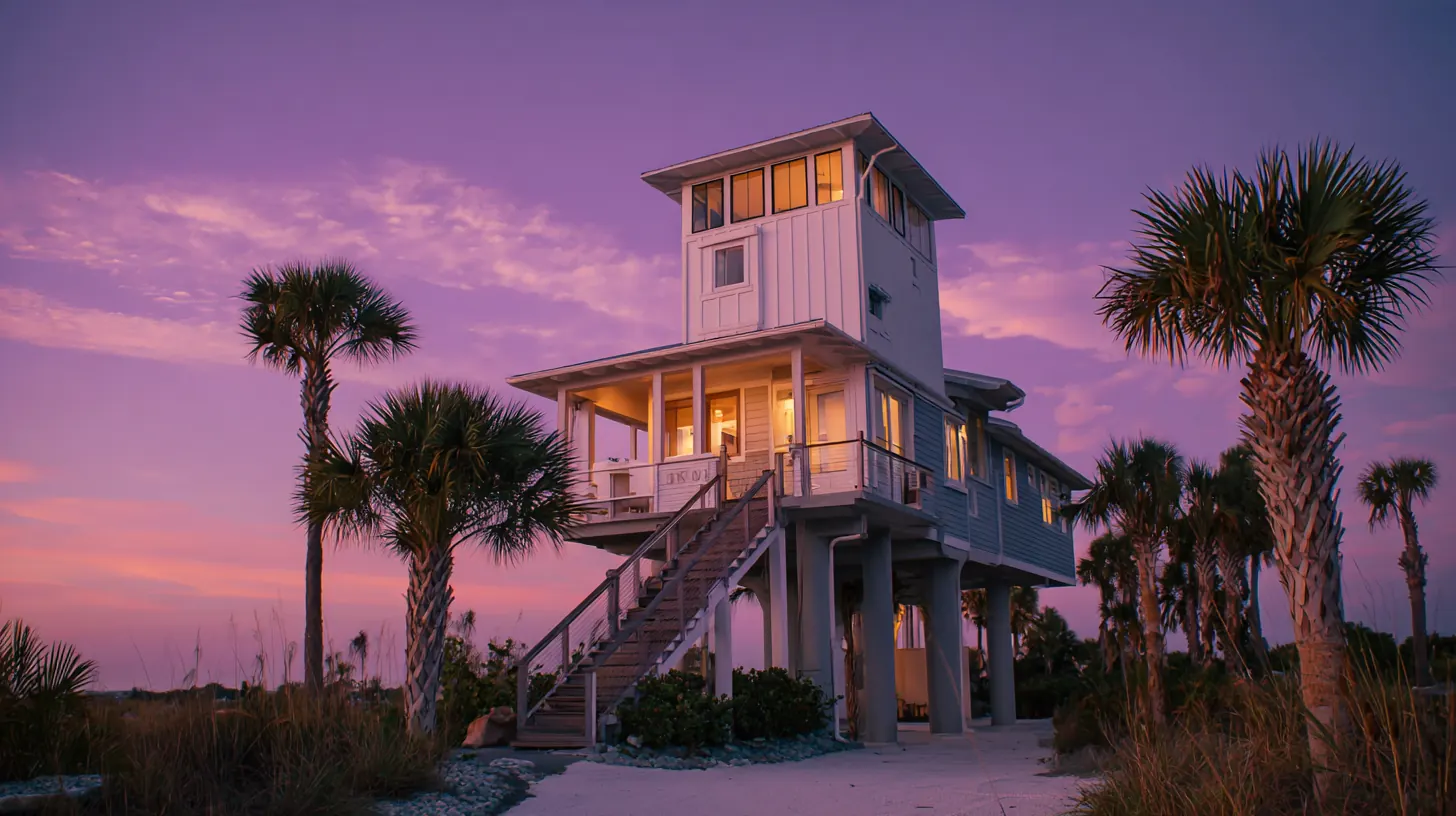
Start with the audit.
About 60 seconds, no email, and you get named findings for your own site, not a score out of a hundred.