What Home Service Businesses Should Get From an SEO Agency Each Month
Most SEO retainers are judged on a monthly report that nobody reads carefully, showing metrics that move whether or not anyone did any work. This is the accountability guide: what should physically arrive each month, what each item is supposed to prove, and the specific signals that mean you are paying for activity rather than progress. We sell these services, so read the red flags with that in mind and apply them to us as readily as to anyone else.
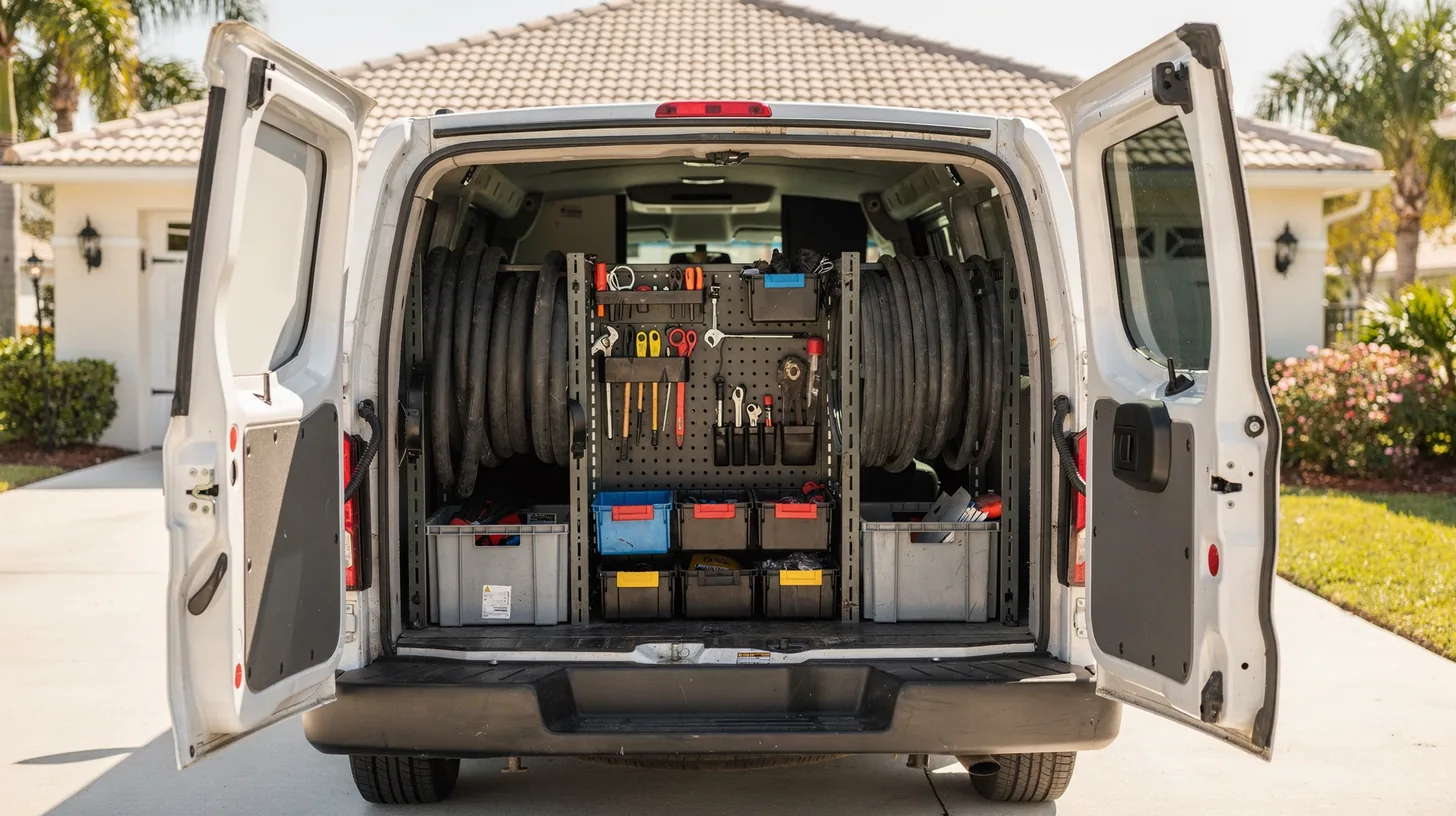
A month of work should be as itemised as a stocked van. If you cannot see what was done, you cannot judge whether it was worth it.
In one paragraph
Monthly SEO deliverables are the specific pieces of work a retainer buys: Google Business Profile maintenance, published or updated pages, technical fixes, link and mention acquisition, and a report tying it to leads. For a home service business the test is whether each item can be pointed at and verified. Vague summaries without artifacts are the main warning sign in home services SEO.
01 / 07
A Retainer Should Buy Artifacts, Not Activity
The difference between a working engagement and a coasting one is whether the month produced things you can point at. Pages exist or they do not. Profile posts were published or they were not. Fixes were deployed or they were not. Activity language such as ongoing optimization describes effort with no artifact attached.
The reason this matters more in SEO than in most services is that the results lag the work by months. In a channel where the outcome arrives late, the only honest short-term accountability is the work itself. If you cannot verify the work and the results have not arrived yet, you have no information at all, which is precisely the position a coasting provider prefers.
The lag also means judging month one on lead volume is unfair and unhelpful in both directions. It punishes good providers early and protects bad ones, because by the time the absence of results is undeniable, a year of fees has gone. Verifying artifacts monthly and results quarterly is the combination that works.
For orientation on what this costs: a survey of more than 300 SEO professionals reported average monthly SEO costs of roughly $1,000 to $2,500, with brackets from under $500 to more than $5,000, and the $1,001 to $2,500 band described as most common (Backlinko, 2026)[1]. That is practitioners reporting their own pricing rather than an official statistic. The number matters less than what it buys: a smaller retainer spent on real work beats a larger one spent on reporting.
Our companion guide on how to evaluate a local SEO agency covers the questions to ask before signing. This one is about the twelve months after.
02 / 07
The Monthly Deliverables Checklist
Not every item belongs in every month, and a provider reasonably concentrates effort where it matters most at the time. What should be constant is that the month produced identifiable work across the areas that actually move local visibility, and that you can see it without asking twice.
Use this as a monthly audit rather than a contractual demand. The right question is not whether every box is ticked, it is whether the pattern over a quarter covers the ground.
| Deliverable | What should arrive | What it proves |
|---|---|---|
| Google Business Profile | Posts published, photos added, Q and A and hours maintained | The highest-weight local asset is being worked, not assumed |
| Reviews | New review count, response rate, the request process in use | The fastest-moving ranking and conversion signal is live |
| Content | Named pages published or substantively updated, with URLs | Coverage is expanding against real customer questions |
| Technical | Specific issues found and fixed, with before and after | Silent failures are being caught, since they surface no errors |
| Links and mentions | Named domains earned, not a count of submissions | Off-site corroboration is growing, which is the slow layer |
| Reporting | Leads and calls first, rankings and traffic as support | The work is being judged against the business outcome |
The profile row belongs at the top for a reason that is measurable. Whitespark 2026 Local Search Ranking Factors report identifies the primary Google Business Profile category as the single most important local ranking factor, with 8 of the top 10 Local Pack factors coming from the profile itself (Whitespark, 2025)[2]. An agency that spends every month on blog posts while your profile sits untouched is working the lower-leverage asset.
The links row is the one most often padded. A report showing hundreds of directory submissions is describing volume of a low-value activity. A report naming three real domains that now mention you is describing something that took actual effort and actually counts.
03 / 07
What Each Deliverable Is Supposed to Prove
A checklist alone lets a provider tick boxes without moving anything. The useful question for each item is what it is evidence of. Once you know what a deliverable is supposed to prove, you can tell the difference between work that advances the account and work that fills a report.
Take content. Four published pages prove nothing on their own; four pages targeting questions your customers actually ask, in their vocabulary, with the answer stated in the opening sentences, prove that coverage is expanding where buyers are searching. The test is not word count. It is whether you recognize the questions as ones your office answers on the phone.
Take reviews. A count proves little; a count plus the response rate plus a description of when and how customers are asked proves there is a working process rather than an occasional push. The thresholds justify the attention: 74 percent of consumers specifically seek reviews written in the last three months and 47 percent will not use a business with fewer than 20 reviews (BrightLocal, 2026)[3], while 80 percent are more likely to use a business that responds to all its reviews (BrightLocal, 2026)[4].
Take technical work. This is the category where you are most dependent on honesty, because the failures are invisible to you: an unindexed page, a broken redirect, a canonical pointing at the wrong URL. None of those produce a complaint or an error message. A technical line item should therefore name the specific issue and show the before and after, because ongoing technical maintenance is exactly the phrase that survives a month of nothing happening.
Take profile work. Accuracy is not cosmetic: 62 percent of consumers would avoid a business entirely if they found incorrect information about it online (BrightLocal, 2023)[5]. For a home service business with seasonal hours and a changing service area, that is a recurring job rather than a one-time setup.
04 / 07
What a Good Monthly Report Contains
A useful report opens with the business outcome and treats search metrics as supporting evidence. A weak one opens with traffic and rankings because those are the numbers most likely to look positive. The order of the sections tells you what the provider believes they are accountable for.
The first section should be leads: calls, forms and messages, with a comparison to previous periods and, where possible, which pages or profile actions produced them. That is the number your business runs on. If the report never reaches it, the provider has chosen metrics they control over metrics you care about.
Rankings belong in the report but not at the front, and they should be honest about which terms matter. A report celebrating movement on a long, obscure phrase nobody searches while the terms that produce work sit unchanged is technically accurate and substantively misleading. Ask which of the reported terms actually produce calls.
Traffic is the weakest of the three headline numbers and deserves the least weight, because in local services a small number of high-intent visits beats a large number of incidental ones. A traffic increase with no corresponding lead increase is a question to ask rather than a success to celebrate.
Two sections should be present that usually are not: what did not work, and what is planned next with a reason. A provider who never reports a failed experiment is either not experimenting or not telling you. Structured reporting is a service in its own right, which is what our SEO reporting work covers.
One newer section is worth requesting now. Some 45 percent of consumers used AI tools to find a local business in the past year, up from 6 percent the year before (BrightLocal, 2026)[6], and assistants are highly selective, with ChatGPT recommending about 1.2 percent of brand locations against 35.9 percent appearing in the local 3-pack (SOCi, 2026)[7]. Whether you are being named is now worth tracking, and our guide on measuring AI search traffic covers how.
05 / 07
Red Flags That Mean You Are Being Coasted
Coasting has recognizable signatures. The common thread is a report that cannot be independently verified, combined with language that describes effort rather than output. None of these individually proves a problem, but two or three together usually mean the account is on maintenance while the invoice is not.
The clearest signal is deliverables that cannot be pointed at. Ongoing optimization, continued monitoring and general improvements are not deliverables. If you cannot open a URL, see a profile post, or read a before and after, nothing was necessarily produced.
The second is reporting that never reaches leads. A report that stops at impressions and rankings has chosen the metrics the provider controls over the metric you are paying for. Related is the report where every number is up and nothing is ever a problem, which is not what a real account looks like over twelve months.
The third is guarantees. Nobody controls Google rankings, and a provider promising specific positions, or a guaranteed AI citation, is describing something outside their control. That should reduce your confidence in everything else in the proposal.
The fourth is silence on the profile. Given that 8 of the top 10 Local Pack factors come from the Google Business Profile (Whitespark, 2025)[2], a provider producing content every month while your profile goes untouched is either not looking at it or hoping you are not.
The fifth is a link report counting submissions rather than naming domains, and the sixth is being unable to get a straight answer about what will happen next month and why. Applied honestly, several of these are tests any agency can fail in a bad quarter, including ours. That is the point: they are diagnostic questions rather than accusations, and the right response from a provider is a direct answer rather than defensiveness.
06 / 07
How to Run a Useful Monthly Check-In
One structured hour a month is enough to keep an engagement honest, and it is the single cheapest protection available on a retainer. The purpose is not to supervise the tactics. It is to confirm that identifiable work happened, that it was aimed at the right things, and that the plan for next month has a reason behind it.
Four questions cover most of it. What was produced this month that I can look at. What did that work aim to move. What is planned next month and why that rather than something else. And what is not working. The fourth is the most useful and the least asked.
Bring one thing to every call: the questions your customers asked you this month. Your office hears the actual language buyers use, and that is the raw material that makes content specific rather than generic. Forwarding five real questions is more valuable to a competent provider than any amount of feedback on keywords.
Set the review horizon honestly at the start. Local ranking signals take weeks to move and content compounds over months, so judge artifacts monthly and outcomes quarterly. Our guide on how long local SEO takes to work sets out what to expect in each phase, and what to budget covers the spending side.
If the answers to those four questions are consistently vague, the problem is usually not the tactics. It is that nobody on the provider side is actively thinking about your account, and that does not improve because you asked more politely.
07 / 07
Judge the Work Monthly and the Results Quarterly
A retainer is working when each month produces artifacts you can verify, aimed at the assets that carry local weight, reported against leads rather than impressions. It is failing when the report is full of activity language and the only way to check is to trust the summary.
Start with one month of the checklist. Ask for the artifacts, read the report from the leads section first, and put the four questions on the next call. Most engagements reveal themselves immediately, in either direction.
Keep the horizon fair while you do it. Verifying artifacts monthly protects you against coasting; judging outcomes quarterly protects a competent provider from being fired during the lag. Both matter, and confusing them is how good engagements get canceled at month three and bad ones survive to month twelve.
If you want an independent read on whether the work being reported is actually present on your site, a free SEO audit will show which pages are indexed and what condition your profile is in. If you are weighing whether to keep paying at all, our guide on doing SEO yourself versus hiring an agency works through that honestly.
Transparency: SEO Elite Agency sells the services described here, so treat this as an interested party setting out a standard rather than a neutral audit. The red flags above apply to us as much as to any provider, and they are worth using that way. Results vary by market, category, and the condition of your existing website and profile. Nobody controls Google rankings.
Watch it work
Turn on what makes AI recommend you.
AI recommends the businesses it can read, trust and quote. Flip on the four signals we engineer, and watch your visibility climb and the answer rewrite itself.
THE FOUR SIGNALS WE ENGINEER
Illustrative · the four signals are the real system we build
Questions
This article, answered.
Jamie Kloncz · SEO Elite Agency, Naples
Work you can point at across the areas that move local visibility: Google Business Profile maintenance including posts, photos and hours; review generation with a stated process and a response rate; named pages published or substantively updated, with URLs; specific technical issues found and fixed, with before and after; named domains that now mention or link to you, rather than a count of submissions; and a report that leads with calls and form fills. Not every item belongs in every month, since a competent provider concentrates effort where it matters most, but over a quarter the pattern should cover that ground.
Jamie Kloncz · SEO Elite Agency, Naples
It opens with leads, which means calls, forms and messages compared with previous periods and, where possible, attributed to the pages or profile actions that produced them. Rankings appear as supporting evidence rather than as the headline, and honestly, naming the terms that actually produce work rather than obscure phrases that happen to have moved. Traffic gets the least weight, because in local services a few high-intent visits beat many incidental ones. Two sections that are usually missing and should not be: what did not work this month, and what is planned next with the reasoning behind it.
Jamie Kloncz · SEO Elite Agency, Naples
Separate the two questions, because they have different timelines. To check whether work is happening, verify artifacts monthly: open the URLs, look at the profile posts, read the before and after on technical fixes, and check that named domains actually mention you. To check whether it is producing results, judge quarterly, because local ranking signals take weeks to move and content compounds over months. The failure mode to avoid is judging results monthly, which punishes competent providers early and protects coasting ones until a year of fees has gone. If artifacts are absent, you do not need to wait for the results to know.
Jamie Kloncz · SEO Elite Agency, Naples
It depends on whether the retainer buys work or reporting. A survey of more than 300 SEO professionals reported average monthly SEO costs of roughly $1,000 to $2,500, with the $1,001 to $2,500 band most common (Backlinko, 2026), though that is practitioners reporting their own pricing rather than an official figure. The number matters less than the composition: a smaller retainer spent on profile work, reviews and real pages beats a larger one spent on reports. For a home service business the profile is the highest-leverage asset, since 8 of the top 10 Local Pack factors come from it (Whitespark, 2025), so check that it is actually being worked.
Jamie Kloncz · SEO Elite Agency, Naples
Deliverables that cannot be pointed at, meaning phrases like ongoing optimization with no URL, artifact or before and after attached. Reporting that never reaches leads and stops at impressions and rankings. Every number being positive every month, which is not what a real account looks like over a year. Guarantees of specific rankings or AI citations, since nobody controls either. A link report counting submissions rather than naming domains. And silence on the Google Business Profile while content is produced every month. Any single one can happen in a bad quarter; two or three together usually mean the account is on maintenance.
Jamie Kloncz · SEO Elite Agency, Naples
Give results a quarter and give artifacts one month. Local ranking signals need weeks to be crawled, evaluated and reflected, and content compounds over months, so a fair outcome assessment sits at roughly ninety days with a fuller picture at six. But that patience applies only to results. Whether work is being produced is verifiable in the first month, and if the first month yields nothing you can open or inspect, waiting ninety days will not improve it. The two clocks are separate: verify effort immediately, judge outcomes later.
Jamie Kloncz · SEO Elite Agency, Naples
The questions your customers actually asked you that month, in their words. Your office hears the real language buyers use before they buy, and no provider has access to that. Forwarding five genuine questions is more useful than any amount of keyword feedback, because it is the raw material that makes content specific rather than generic. Beyond that, bring the four questions: what was produced that I can look at, what was it meant to move, what is planned next and why, and what is not working. The last one is the most useful and the least asked.
Sources
- 1Backlinko: SEO Pricing, survey of more than 300 SEO professionals, updated December 2025 - average monthly SEO cost roughly $1,000 to $2,500, most common bracket $1,001 to $2,500↩
- 2Whitespark: 2026 Local Search Ranking Factors - the primary Google Business Profile category is the single most important local ranking factor; 8 of the top 10 Local Pack factors come from the profile↩
- 3BrightLocal: Local Consumer Review Survey 2026 - 74 percent seek reviews written in the last three months; 47 percent will not use a business with fewer than 20 reviews↩
- 4BrightLocal: Local Consumer Review Survey 2026 - 80 percent are more likely to use a business that responds to all of its reviews↩
- 5BrightLocal: Local Business Discovery and Trust Report, 2023 - 62 percent would avoid a business that has incorrect information online↩
- 6BrightLocal: Local Consumer Review Survey, AI Trust, March 2026 - 45 percent of consumers used AI to find a local business, up from 6 percent↩
- 7SOCi: 2026 Local Visibility Index, January 2026 - ChatGPT recommends about 1.2 percent of brand locations versus 35.9 percent in the Google local 3-pack↩

Written by
SEO Elite Agency, Naples FL. Published .
Check this page has not changed
Every article is hashed when the site is built. This recomputes the hash of its text in your browser and compares it with the published record.
Related services