
NAPLES, FL · MANUFACTURING SEO
Manufacturing SEO that gets you specified, not just found
A procurement manager sourcing a machined part does not type "near me" and does not open a map. They type a material, a process, and a tolerance, and one supplier's page answers exactly. Industrial search rewards precision over proximity, and it is the one corner of SEO where being local barely matters.
 Jamie Kloncz, founder. Does the work himself, from Naples.
★★★★★ 5.0 on GoogleNaples, FloridaMonth to month
In one paragraph
SEO Elite Agency provides manufacturing SEO for industrial companies, contract manufacturers, and job shops as part of our Naples SEO services: capability and specification pages built for the technical terms engineers and procurement teams actually search, structured data for products and processes, and content engineered to be cited by AI research tools. We are based in Naples, Florida, work month-to-month with no long-term contracts, and begin every engagement with a free visibility audit.
01 / 09
What is manufacturing SEO and how is it different from local SEO?
Manufacturing SEO is business-to-business search optimization for industrial companies. It sets aside the map pack and "near me" queries that drive local SEO, because a buyer sourcing a part rarely cares where a supplier sits. Instead it targets precise technical terms, serves long multi-stakeholder buying cycles, and treats capability and specification pages as the product being marketed.
Local SEO lives on proximity, reviews, and a Google Business Profile. Industrial search runs on none of that. The searcher already knows exactly what they need before they type: a specific alloy, a forming process, a dimensional tolerance, an industry certification, and they are shortlisting suppliers that can prove they do that one thing well.
Geography is rarely the deciding factor. A design engineer in Ohio sourcing a titanium bracket will happily evaluate a shop in Southwest Florida if the capability page shows it holds the tolerance and runs the right equipment. Distance loses to capability match, which flips the entire local-SEO playbook on its head.
And the buyer arrives late. B2B buyers spend only 17% of the purchase journey meeting with potential suppliers, and about 27% of their time researching independently online (Gartner, 2019). By the time a request for quote reaches you, your website has already done most of the selling, silently.
How an engineer finds a supplier
Capability beats proximity.
01 / 04 · Before they type
“The searcher already knows exactly what they need before they type: a specific alloy, a forming process, a dimensional tolerance, an industry certification”
02 / 04 · Distance loses
“Distance loses to capability match, which flips the entire local-SEO playbook on its head.”
03 / 04 · 17% with suppliers
“B2B buyers spend only 17% of the purchase journey meeting with potential suppliers, and about 27% of their time researching independently online (Gartner, 2019).”
04 / 04 · Already sold
“By the time a request for quote reaches you, your website has already done most of the selling, silently.”
02 / 09
What keywords do industrial buyers actually search for?
Highly specific ones: material grades, process names, part numbers, dimensional tolerances, and capability-plus-industry combinations. Each term draws almost no monthly volume, which most keyword tools treat as worthless. But the intent is enormous and the deal size is large. The engineer searching "AS9100 investment casting" is not browsing, they are sourcing, right now.
Think "6061-T6 aluminum CNC machining", "ID grinding 0.0002 tolerance", or "medical-grade PEEK micromachining". A volume-obsessed tool shows a flat line and tells you to skip it. That advice is wrong for manufacturing. One qualified RFQ from a term with ten searches a month can be worth more than a thousand consumer clicks. We cannot promise the RFQ, but we can put your page in front of the person typing that exact spec.
Head terms like "CNC machining" or "metal stamping" are the trap. They are dominated by large aggregators and national shops, they cost the most to chase, and the searcher behind them is usually early and unqualified. The mid-size shop competes and wins in the long tail, where the query is precise enough that few pages even try to answer it.
Engineers also search in the language of drawings and standards, not marketing. Copy promising "world-class quality solutions" ranks for nothing and repels a technical reader on sight. We match the vocabulary of the spec sheet, meaning grades, standards, processes, and tolerances, because that is what the buyer typed and what the page has to mirror.
Searched in the language of drawings
Ten searches a month, one real RFQ.
01 / 04 · Sourcing
“The engineer searching "AS9100 investment casting" is not browsing, they are sourcing, right now.”
“Each term draws almost no monthly volume, which most keyword tools treat as worthless.”
02 / 04 · Material
“One qualified RFQ from a term with ten searches a month can be worth more than a thousand consumer clicks.”
“A volume-obsessed tool shows a flat line and tells you to skip it.”
03 / 04 · Tolerance
“The mid-size shop competes and wins in the long tail, where the query is precise enough that few pages even try to answer it.”
“Head terms like "CNC machining" or "metal stamping" are the trap.”
04 / 04 · Vocabulary
“We match the vocabulary of the spec sheet, meaning grades, standards, processes, and tolerances, because that is what the buyer typed and what the page has to mirror.”
“Copy promising "world-class quality solutions" ranks for nothing and repels a technical reader on sight.”
03 / 09
Why are capability and specification pages the core asset for a manufacturer?
Because engineers search by capability, so your site should be organized by capability. Each material you work, each process you run, each industry you serve, and each certification you hold deserves its own page. That structure gives search engines and AI systems a distinct, indexable answer for every query, instead of one overloaded "Capabilities" page that ranks for nothing in particular.
The common mistake is a single page listing forty processes in a wall of text. It competes for none of them. Split it: a page for each material family, a page for each process, a page for each industry served, a page for major equipment or envelope sizes. Link them into clusters so both crawlers and readers can see how your capabilities relate.
Every one of those pages has to carry real detail, meaning the machine list, work-envelope dimensions, tolerances routinely held, secondary operations offered, typical lead times, and the industries you supply. That specificity is simultaneously the ranking signal and the exact criterion a procurement team uses to shortlist. Vague pages get neither the ranking nor the RFQ.
You do not need hundreds of these. You need the pages that match what you genuinely do and the work you want more of. A focused set of honest capability pages outperforms a bloated site that claims processes you rarely run, which erodes trust the moment a real quote request exposes the gap.
The detail a buyer shortlists on
Machine list, envelope, tolerance.
01 / 04 · A wall of text
“The common mistake is a single page listing forty processes in a wall of text.”
02 / 04 · The machine list
“Every one of those pages has to carry real detail, meaning the machine list, work-envelope dimensions, tolerances routinely held, secondary operations offered, typical lead times, and the industries you supply.”
03 / 04 · Ranking and shortlist
“That specificity is simultaneously the ranking signal and the exact criterion a procurement team uses to shortlist.”
04 / 04 · What you genuinely do
“You need the pages that match what you genuinely do and the work you want more of.”

04 / 09
What kind of content wins over design engineers and procurement managers?
Evidence, not adjectives. Spec sheets, tolerance tables, material data, downloadable CAD files, and application notes answer the questions a technical buyer actually has. The convenient part: that same depth is what wins long-tail search and what AI answer engines quote, because generative models reward concrete statistics, cited sources, and specific detail (Aggarwal et al., KDD 2024).
The GEO research is direct about this. Adding relevant statistics, citing credible sources, and including authoritative quotations raised a page's visibility in generative engines by up to 40%, varying by domain (Aggarwal et al., KDD 2024). Technical manufacturing content is naturally dense with exactly those elements, meaning real numbers, named standards, and measured tolerances, so it starts with an advantage most marketing copy never has. Turning that depth into a genuine library is what our content marketing services do.
Downloadable spec and CAD files pull double duty. They give an engineer what they need to design your part into their assembly, and they attract the kind of technical links and references that establish genuine expertise. Light gating tends to beat heavy gating here, because a buyer in early research will simply leave rather than fill out a form to see a tolerance.
There is a delivery trap to avoid. AI crawlers fetch raw HTML and do not run JavaScript: GPTBot requested script files on 11.5% of its fetches and ClaudeBot on 23.8%, and neither ever executed them (Vercel, 2024). A spec table injected by a script, or a datasheet locked behind a form, is invisible to those systems, so the specifications belong in the page HTML itself, which is where our technical SEO services start.
Evidence, not adjectives
What an engineer actually downloads.
01 / 05 · Up to 40%
“Adding relevant statistics, citing credible sources, and including authoritative quotations raised a page's visibility in generative engines by up to 40%, varying by domain (Aggarwal et al., KDD 2024).”
02 / 05 · Measured tolerances
“Technical manufacturing content is naturally dense with exactly those elements, meaning real numbers, named standards, and measured tolerances”
03 / 05 · Designed in
“They give an engineer what they need to design your part into their assembly”
04 / 05 · Light gating
“Light gating tends to beat heavy gating here, because a buyer in early research will simply leave rather than fill out a form to see a tolerance.”
Asset
Spec sheets
Spec sheets
Asset
Tolerance tables
tolerance tables
Asset
CAD files
downloadable CAD files
Asset
Application notes
application notes
A technical library
Diagram. The assets as this section names them.
05 / 09
Do certifications like ISO 9001 and AS9100 help SEO?
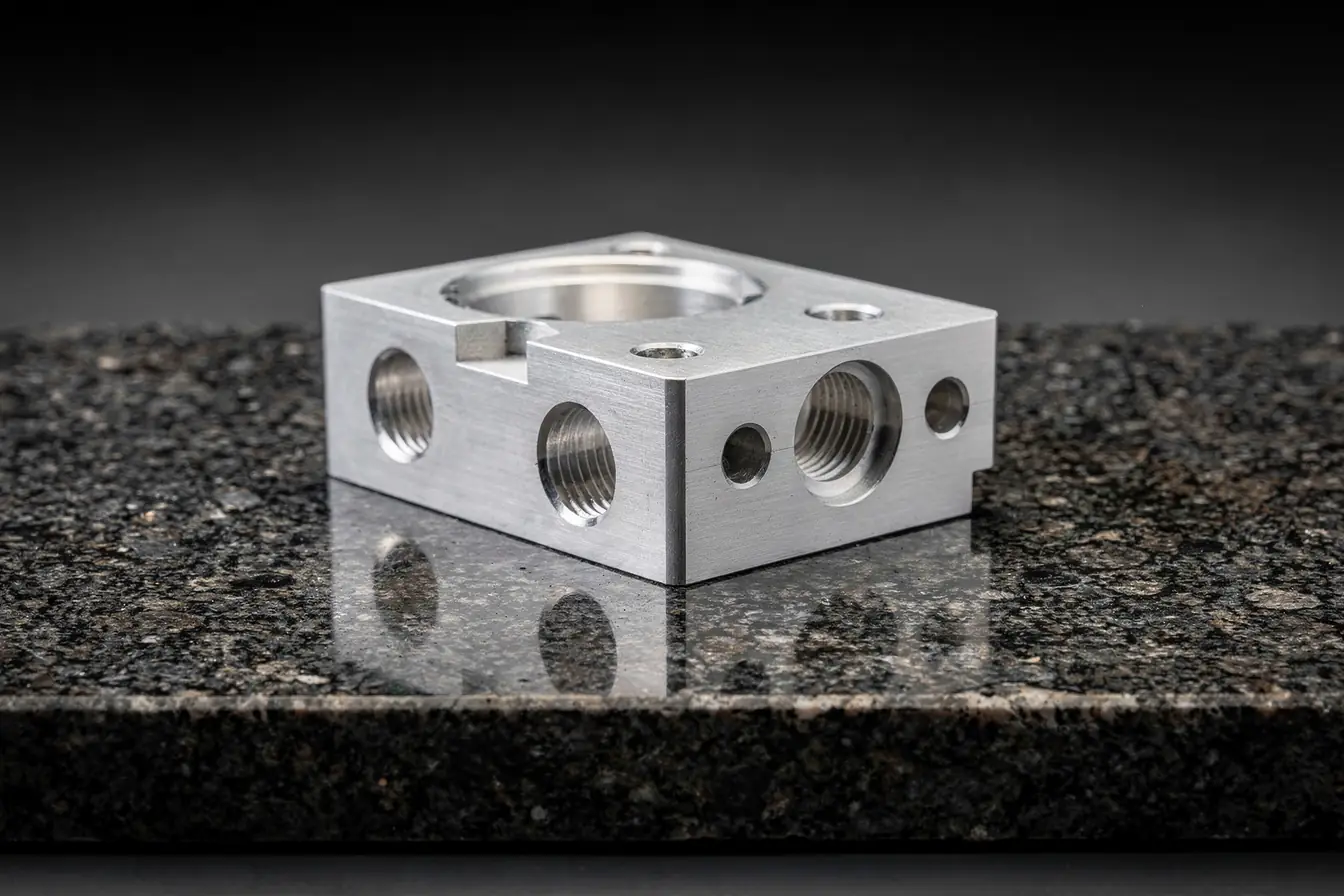
They function as shortlisting gates in industrial buying, and naming the ones you genuinely hold is both a trust signal and a search signal. Buyers search directly for suppliers with a specific certification, whether ISO 9001, AS9100, IATF 16949, or ITAR registration, so a dedicated, honestly written quality page captures those queries and clears a real procurement filter at the same time.
Procurement often filters by certification before it evaluates anything else. No AS9100, no aerospace RFQ; no ITAR registration, no defense work. So the certifications you actually hold deserve their own page, marked up in schema, and stated consistently across your site and industrial profiles, because that is precisely what a qualified buyer is screening for.
This is where honesty is not optional. We state certifications as examples of what matters in industrial search, never as claims about any particular client, and we will never publish a credential a business does not hold. A false certification claim is the fastest way to lose a deal at the audit stage and, in regulated sectors, far worse than a lost deal.
Certifications also read as trust signals to AI systems the same way they do to buyers. Stated clearly on your own page and corroborated across the directories and databases the models already reference, they help an answer engine be confident about who you are and what you are qualified to make.
The certification gate
Filtered before anything else.
A false certification claim is the fastest way to lose a deal at the audit stage and, in regulated sectors, far worse than a lost deal.
Which work are you after?
06 / 09
How does the long B2B buying cycle change SEO measurement and attribution?
Industrial deals move through a buying group, meaning a design engineer, a purchasing agent, and a quality lead, over months. Most of those touches leave no trackable trail, so content assists far more than it visibly converts. Judging manufacturing SEO by last-click RFQs undercounts it badly. We measure assisted pipeline and the capability terms your content is getting found for.
The math is against clean attribution. Buyers spend just 17% of the journey with suppliers and roughly 27% researching on their own (Gartner, 2019), which means a page can be read, compared, and mentally shortlisted long before anyone identifies themselves. When the RFQ finally lands, the form rarely records the six earlier visits that earned it.
We are honest about that limit rather than papering over it with a tidy last-click chart. A spec page read in March can surface as a quote request in September, routed through a distributor, with no visible link back to the search that started it. Anyone claiming precise multi-touch attribution in industrial B2B is overselling the data.
So we track what is real: organic visibility on your target capability terms, quote-request and contact volume, the pages that most often precede an RFQ, and assisted conversions where the tooling can see them. That is a more honest scoreboard than a rankings screenshot, and it keeps the work pointed at pipeline rather than vanity positions.
07 / 09
What role do platforms like Thomasnet play in industrial SEO?
Platforms such as Thomasnet are where many engineers and buyers begin industrial sourcing, so a complete, accurate profile there matters. But a directory is space you rent, not an asset you own. It complements an optimized website rather than replacing it. The aim is to be found on both, with identical capability details and specifications across them.
In-market demand
Thomas reports that its network carries more than 950,000 active buyers and over 500,000 supplier profiles, which is real, in-market industrial demand you want to appear in front of. Being listed, complete, and specific there is table stakes for many manufacturers, in the same way a claimed profile is table stakes for a local business.
Rented, not owned
The catch is control. You do not own the platform, its ranking rules, or the lead, which is often shared with competitors the moment it comes in. Your own capability pages, ranking in Google and cited by AI, are the asset that compounds and that no platform can take away. The directory feeds you; the website builds you.
One set of facts
The discipline is the same one that governs a Google Business Profile in local SEO: accurate categories, complete and consistent specifications, and no contradictions between the directory and your site. Conflicting details across sources make both search engines and AI systems less sure of who you are, which quietly costs you the shortlist.

08 / 09
How do you get a manufacturer cited by AI answer engines?
AI research tools are becoming a genuine part of B2B sourcing, and a manufacturer earns a citation the same way it earns a ranking: an unambiguous identity through Organization and Product schema, specific technical content a model can quote, and corroboration across trusted sources. Branded mentions track AI visibility far better than link counts do (Ahrefs, 2025).
The correlation data points the way. Across 75,000 brands, branded web mentions correlated with AI visibility at roughly 0.66 to 0.71, while link metrics correlated only very weakly (Ahrefs, 2025). For a manufacturer, that means being named in trade publications, industrial directories, and specification databases matters more than a pile of low-quality backlinks ever will, which is why our link building services focus on earned mentions over volume.
Schema does structural work here without being a magic switch. We implement Organization and Product markup so a machine knows exactly which company and which capability it is reading. We are also honest about the measured effect: adding schema moved AI citations by +2.4% in AI Mode and +2.2% in ChatGPT, both statistically indistinguishable from zero (Ahrefs, 2026). It buys eligibility and clarity, not a guaranteed mention, and building genuine AI visibility is the work of our GEO and AI search optimization.
Two practical notes. Bing matters more than most B2B firms expect: about 87% of SearchGPT citations matched Bing's top organic results (Seer Interactive, 2025), so a claimed, complete Bing presence is part of the work. And skip the shortcuts: 97% of the valid llms.txt files Ahrefs studied received no requests of any kind (Ahrefs, 2026). There is no file you publish that forces a citation.
ChatGPT
Does my location matter for manufacturing SEO?
Far less than it does for local SEO. Industrial buyers source on capability, not proximity, so a shop in Naples can win a job from a buyer anywhere in the country if the spec matches. We optimize for material, process, and tolerance terms rather than "near me" queries, because that is how procurement actually searches.
Google AI Mode
My best keywords have almost no search volume. Is SEO still worth it?
Often yes. Industrial terms are low-volume, high-intent, and high-value, and one qualified RFQ can dwarf a month of consumer clicks. We cannot promise an RFQ, and we will not pretend otherwise, but the engineer searching an exact material grade and tolerance is deep inside a real purchase, not browsing.
Perplexity
Should I put spec sheets and CAD files behind a form?
Usually light gating or none wins. Heavily gated files repel engineers early in research, and content that only loads via JavaScript or sits behind a form cannot be read by AI crawlers at all (Vercel, 2024). Capturing a lead is worth less than being the supplier whose specifications a buyer could actually design in.
Gemini
Do I still need my own website if I already advertise on Thomasnet?
Yes. A directory profile is rented and shared, and the platform controls the rules and the lead. Your capability pages are an owned asset that can rank in Google and be cited by AI research tools. Do both, and keep the specifications identical across them so nothing contradicts.
Copilot
Can you get us cited by ChatGPT for our processes?
We can build the conditions, meaning a clear entity, Organization and Product schema, quotable technical content, and corroborating mentions, but no one controls what a model cites, so we will not promise it. Branded mentions track AI visibility better than links do (Ahrefs, 2025), which is where we focus the effort.
Claude
We hold ISO 9001 and AS9100, how should that show up?
Only the certifications you genuinely hold, stated plainly on a dedicated quality page, marked up in schema, and repeated consistently across your profiles. Buyers filter by certification before they evaluate anything else, so it is both a trust signal and a search signal. We never publish a credential a business does not actually have.
The answer an engine can quote is the one on your page. These answers are this page’s own.
Manufacturer questions, asked of AI
Location, volume, CAD files.
01 / 06 · Asked in ChatGPT
“Does my location matter for manufacturing SEO?”
Reads fromOpenAI’s own search crawler, OAI-SearchBot. OpenAI says it is the bot used to surface websites in ChatGPT’s search answers.
02 / 06 · Asked in Google AI Mode
“My best keywords have almost no search volume. Is SEO still worth it?”
Reads fromThe Google Search index, plus your Google Business Profile.
03 / 06 · Asked in Perplexity
“Should I put spec sheets and CAD files behind a form?”
Reads fromIts own index, built by PerplexityBot.
04 / 06 · Asked in Gemini
“Do I still need my own website if I already advertise on Thomasnet?”
Reads fromGoogle’s index, with one extra switch: Google-Extended.
05 / 06 · Asked in Copilot
“Can you get us cited by ChatGPT for our processes?”
Reads fromThe Bing index.
06 / 06 · Asked in Claude
“We hold ISO 9001 and AS9100, how should that show up?”
Reads fromAnthropic’s Claude-SearchBot, and Brave Search.
09 / 09
Does a small custom job shop need a big content operation?
No. For a small custom job shop, a handful of precise capability pages that match what you do, and the work you want more of, beats a sprawling content program you cannot sustain. The right scope is the smallest set of pages that covers your real capabilities thoroughly, not the largest set a budget can be talked into funding.
Big content operations suit high-volume manufacturers and multi-division suppliers with dozens of processes and markets to cover. A twelve-person shop competes far better with six excellent, specific pages than with sixty thin ones. Depth on the capabilities you actually own beats breadth across capabilities you occasionally touch, every time.
The economics stay grounded. Most SEO projects fall in the $1,000 to $5,000 range, and 34% of US, UK, and Australian providers charge $2,501 to $5,000 per month (Backlinko, 2026), while 68.8% of agencies charge $2,000 a month or less (Ahrefs, 2024). You can see how we structure engagements on our SEO pricing packages page. We quote after a free audit, scoped to your real capabilities and goals, never from a package tier decided in advance.
We are based at 1950 Mayfair Street, Suite 313 in Naples, hold a 5.0 rating on Google, and work month-to-month with no long-term contract. The free audit shows exactly where you stand on the capability terms that matter and where AI systems do or do not name you. If a shop is a bad fit for SEO, we will say so rather than take the retainer. Reach us at (843) 955-7727 or [email protected].
What manufacturing SEO costs
Six excellent pages, not sixty thin ones.
02 / 04 · The upper third
“34% of US, UK, and Australian providers charge $2,501 to $5,000 per month (Backlinko, 2026)”
03 / 04 · Most agencies
“68.8% of agencies charge $2,000 a month or less (Ahrefs, 2024)”
04 / 04 · Scoped to the shop
“We quote after a free audit, scoped to your real capabilities and goals, never from a package tier decided in advance.”
“If a shop is a bad fit for SEO, we will say so rather than take the retainer.”
Estimate it
What might SEO cost and take for you?
Three questions, an honest range. This uses real Southwest Florida market rates and observed timelines, not a canned package price. It is an estimate to orient you, never a quote. The real number comes from a free audit of your actual site.
1 · HOW COMPETITIVE IS YOUR MARKET?
2 · WHERE IS YOUR SITE TODAY?
3 · WHAT ARE YOU AFTER?
ILLUSTRATIVE ESTIMATE
TYPICAL MONTHLY INVESTMENT
$1,700 – $3,100
/ month · month-to-month
TIME TO MEANINGFUL RESULTS
3 – 6 months
map pack movement, then attributed leads
Estimate from Southwest Florida market rates. Not a quote. Your audit sets the actual scope and price.
Watch it work
Turn on what makes AI recommend you.
AI recommends the businesses it can read, trust and quote. Flip on the four signals we engineer, and watch your visibility climb and the answer rewrite itself.
THE FOUR SIGNALS WE ENGINEER
Illustrative · the four signals are the real system we build
Questions
What owners ask us first.
Jamie Kloncz · SEO Elite Agency, Naples
Far less than it does for local SEO. Industrial buyers source on capability, not proximity, so a shop in Naples can win a job from a buyer anywhere in the country if the spec matches. We optimize for material, process, and tolerance terms rather than "near me" queries, because that is how procurement actually searches.
Jamie Kloncz · SEO Elite Agency, Naples
Often yes. Industrial terms are low-volume, high-intent, and high-value, and one qualified RFQ can dwarf a month of consumer clicks. We cannot promise an RFQ, and we will not pretend otherwise, but the engineer searching an exact material grade and tolerance is deep inside a real purchase, not browsing.
Jamie Kloncz · SEO Elite Agency, Naples
Usually light gating or none wins. Heavily gated files repel engineers early in research, and content that only loads via JavaScript or sits behind a form cannot be read by AI crawlers at all (Vercel, 2024). Capturing a lead is worth less than being the supplier whose specifications a buyer could actually design in.
Jamie Kloncz · SEO Elite Agency, Naples
Yes. A directory profile is rented and shared, and the platform controls the rules and the lead. Your capability pages are an owned asset that can rank in Google and be cited by AI research tools. Do both, and keep the specifications identical across them so nothing contradicts.
Jamie Kloncz · SEO Elite Agency, Naples
We can build the conditions, meaning a clear entity, Organization and Product schema, quotable technical content, and corroborating mentions, but no one controls what a model cites, so we will not promise it. Branded mentions track AI visibility better than links do (Ahrefs, 2025), which is where we focus the effort.
Jamie Kloncz · SEO Elite Agency, Naples
Only the certifications you genuinely hold, stated plainly on a dedicated quality page, marked up in schema, and repeated consistently across your profiles. Buyers filter by certification before they evaluate anything else, so it is both a trust signal and a search signal. We never publish a credential a business does not actually have.
Jamie Kloncz · SEO Elite Agency, Naples
By assisted pipeline, quote requests, and visibility on your target capability terms, not last click. A page read in spring can produce an RFQ months later, routed through a distributor, with no visible link back to the search. We track those leading indicators honestly instead of overclaiming attribution the data cannot support.
Sources
- Gartner: The B2B Buying Journey (17% with suppliers, ~27% independent online research)
- Thomasnet: Product Sourcing and Supplier Discovery Platform
- Vercel: The rise of the AI crawler (AI crawlers do not execute JavaScript), 2024
- Aggarwal et al.: GEO, Generative Engine Optimization (KDD 2024)
- Ahrefs: Brand mentions and AI visibility correlation (75k brands), 2025
- Ahrefs: We tracked 1,885 pages adding schema; AI citations barely moved, 2026
- Seer Interactive: 87% of SearchGPT citations match Bing top results, 2025
- Ahrefs: llms.txt study (97% of valid files got no requests of any kind), 2026
- Backlinko: How Much Does SEO Cost? (pricing survey), 2026
- Ahrefs: SEO Pricing, How Much Does SEO Cost? (68.8% of agencies charge <=$2,000/mo), 2024
Keep reading
Written by Jamie Kloncz, founderSEO Elite Agency, Naples FL. Last updated .
Start with the audit.
About 60 seconds, no email, and you get named findings for your own site, not a score out of a hundred.